
How this page is funded: we earn a commission if you buy through the links below, at no extra cost to you. As an Amazon Associate we earn from qualifying purchases. It does not change which products we pick or the order they appear in. Full disclosure.
How these picks were made: by comparing published specifications and clearly-credited public reporting. We do not run a laboratory, we have not measured these products, and we do not claim to have slept with them. Here is exactly how we choose.
You tried your normal earbuds. Within twenty minutes the one you were lying on was grinding into your ear canal, and by 3am the battery was dead anyway. Sleep earbuds exist because those are two genuinely hard engineering constraints, and solving them costs money.
Why regular earbuds fail you
A standard true-wireless earbud protrudes 10-15 mm from the ear. Lie on your side and your own head weight drives that stem into the side of your head. Sleep earbuds are designed low and flat, with wings that hold them in place without needing a deep canal seal to stay put.
The second constraint is battery. A normal bud is designed for a two-hour commute, not an eight-hour night. Anker rates the Sleep A20 at 14 hours per charge and 80 hours total with its case - and 14 hours is the number that matters, because it means the buds outlast the night with room for a nap.
What they actually do to noise
Sleep earbuds do two separable things and it is worth knowing which you are buying.
- Passive isolation. The physical seal of the tip in your ear. Anker specifies 30 dB of high-frequency passive noise reduction on the Sleep A20. Passive isolation is excellent on high frequencies - voices, clatter, traffic hiss.
- Masking audio. Sound played into your ear to cover what gets through. This is the same masking principle as a white noise machine, delivered closer to your eardrum so it works at much lower volume.
- Active noise cancellation. Only the Sleep A30 in this list has it, and it matters for one specific reason - ANC works best exactly where passive isolation is weakest, in the low frequencies. Which is where snoring lives.
The honest alternative that beats all three
If what you want is silence rather than audio, stop here and buy earplugs. A foam plug rated NRR 33 blocks more than any of these buds, costs a fraction, never needs charging and cannot die at 3am. We would rather tell you that than sell you the expensive answer - the earplug roundup is here.
Sleep earbuds are worth the money when you specifically want to listen to something - a podcast, an audiobook, a masking soundscape - or when you have tried earplugs and cannot tolerate anything sealed in your ear canal. If you cannot tolerate in-ear at all, a headband is the direction to go.
What to check before you buy
- Profile height. The single spec that decides whether you can side sleep in them. Lower is better, always.
- Rated battery per charge, not case total. “80 hours” on a box usually means the case; you need the per-charge number to cover a night.
- Whether it streams or only plays a library. Some sleep buds play only their own app’s soundscapes. If you fall asleep to podcasts, check this first.
- Tip sizes included. Fit is everything for passive isolation, and a bud that does not seal blocks nothing.
- Alarm behavior. If you sleep in buds you need to know how you will wake up - the same problem covered on earplugs that still let you hear your alarm.
The part nobody mentions
Anything sealed in your ear canal for eight hours a night, every night, is a hygiene commitment. Wipe the tips down regularly, replace them when they get tacky, and give your ears a night off now and then. If you develop irritation or discomfort that persists, stop using them and talk to a clinician - that is a medical question and not one for a gear site.
Three sleep earbuds worth the money
Tap any row to jump to the full write-up. The photographs are licensed stock images chosen to illustrate the category - they are not photographs of these specific products, and each one’s alt text describes what is actually shown.
| # | Product | Best for | The spec that decides it | Price |
|---|---|---|---|---|
| 1 | 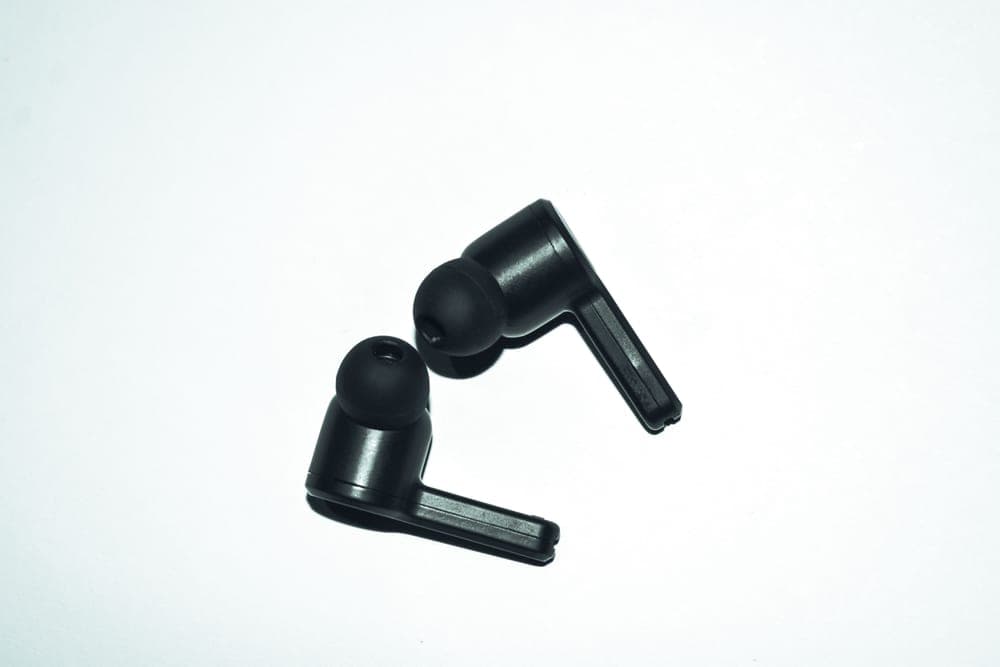 Soundcore Sleep A20Low-profile buds designed to be lain on, with the battery life to actually cover a full night plus a nap. | The value pick in sleep earbuds | 30 dB high-frequency passive noise reduction, 14 h per charge | |
| 2 |  Soundcore Sleep A30The first sleep earbud with active noise cancellation, tuned for the low-frequency rumble that passive isolation cannot touch. | A snoring partner, specifically | Active noise cancellation with adaptive snore masking | |
| 3 |  Ozlo SleepbudsBuilt by ex-Bose engineers around passive sealing and tuned masking soundscapes rather than raw volume. | Light sleepers who want a sealed-room feeling | Passive sealing plus purpose-tuned masking audio |
We have no live price feed for this site yet, so every button reads “Check price on Amazon” rather than showing a number that could be out of date. As an Amazon Associate we earn from qualifying purchases.
Our top pick · The value pick in sleep earbuds
1. Soundcore Sleep A20
Low-profile buds designed to be lain on, with the battery life to actually cover a full night plus a nap.
- Noise reduction:
- 30 dB high-frequency, passive (manufacturer figure)
- Battery:
- 14 h per charge, 80 h total with the case
- Profile:
- Low-profile shell with ear wings, built for side sleeping
- Bluetooth:
- 5.3 - streams any audio source
What it gets right
- Passive isolation plus masking audio is a stronger combination than either alone
- Battery outlasts the night, which most true-wireless buds do not
- Streams anything, so you are not locked into one app's sound library
Where it falls short
- No active noise cancellation - that is the A30
- Passive isolation is weakest exactly where snoring lives, in the low frequencies
- Anything in your ear canal all night is a hygiene commitment
Skip it if: You just want silence. Earplugs block more, cost a fraction, and never need charging.
Pick 2 · A snoring partner, specifically
2. Soundcore Sleep A30
The first sleep earbud with active noise cancellation, tuned for the low-frequency rumble that passive isolation cannot touch.
- Noise reduction:
- Active noise cancellation plus passive isolation
- Snore masking:
- Adaptive - responds to detected snoring
- Profile:
- Low-profile, side-sleeper oriented
- App:
- Yes, with sleep tracking
What it gets right
- ANC targets the low frequencies foam plugs and passive buds both struggle with
- Adaptive masking means the volume is not held constant all night
- Undercuts the premium sleep-bud competition on price
Where it falls short
- Most expensive option in this category by a wide margin
- ANC draws power, so battery life is shorter than the A20
- Feature depth you will never use if all you want is quiet
Skip it if: Your noise is high-frequency - traffic, chatter, a TV next door. Passive blocking handles that for far less.
Pick 3 · Light sleepers who want a sealed-room feeling
3. Ozlo Sleepbuds
Built by ex-Bose engineers around passive sealing and tuned masking soundscapes rather than raw volume.
- Approach:
- Passive seal plus masking soundscapes
- Battery:
- Around 14 h rated
- Profile:
- Light, low-profile shell
- Sounds:
- Curated masking library with sleep modes
What it gets right
- The seal is the strongest passive isolation among the buds we shortlisted
- Masking soundscapes are tuned for the job rather than repurposed music presets
- Comfortable enough to keep in all night
Where it falls short
- Premium price for what is, functionally, a masking device
- Library-driven rather than stream-anything
- Small ecosystem compared with the Anker line
Skip it if: You want to fall asleep to your own podcasts and audiobooks. Pick buds that stream freely.
Questions people actually ask
Are sleep earbuds worth it?
If you want to listen to something as you fall asleep, or you cannot tolerate foam earplugs, yes. If you simply want silence, no - a foam earplug rated NRR 33 blocks more than any sleep earbud, costs a fraction and never runs out of battery.
Do sleep earbuds block snoring?
Passive isolation alone struggles, because snoring is low-frequency and passive sealing works best on high frequencies. Active noise cancellation targets exactly that gap, which is why the ANC model is the one we would point a partner of a snorer towards.
Can you sleep on your side with sleep earbuds?
That is what they are designed for. Sleep earbuds sit far flatter than ordinary true-wireless buds and use wings rather than depth to stay in. Standard earbuds protrude 10-15 mm and become painful within about twenty minutes on a pillow.
How long do sleep earbuds last on a charge?
The models worth buying are rated around 14 hours per charge, which covers a full night with room to spare. Always check the per-charge rating rather than the total including the case - an 80-hour figure on the box usually refers to the case.
Will I hear my alarm through sleep earbuds?
Usually yes, because most sleep earbuds can play the alarm themselves through the buds. That is a genuine advantage over foam earplugs, where the alarm has to get through 33 dB of foam.
Sources
Back to the best white noise machines.
Read next
- Best earplugs for sleepingThe cheaper answer, if silence is all you want.Read it
- Best sleep headphonesIf nothing in your ear canal is tolerable.Read it
- Your partner snores and you can't sleepThe problem most sleep-earbud buyers are actually solving.Read it
- Best sleep masks with headphonesLight and sound in a single piece of gear.Read it