
How this page is funded: we earn a commission if you buy through the links below, at no extra cost to you. As an Amazon Associate we earn from qualifying purchases. It does not change which products we pick or the order they appear in. Full disclosure.
How these picks were made: by comparing published specifications and clearly-credited public reporting. We do not run a laboratory, we have not measured these products, and we do not claim to have slept with them. Here is exactly how we choose.
Short version: if you want genuine active noise cancellation for sleep, the Soundcore Sleep A30 is the pick, because it is an earbud with real ANC tuned at low-frequency rumble and adaptive snore masking. If your noise is higher-pitched - traffic, voices, a television through a wall - you do not need cancellation at all, and a 33 dB foam plug costing a few dollars will outperform anything marketed as a canceling earplug. Almost every product sold under that phrase is passive muffling with a modern name.
This page exists because the phrase is doing real damage to people’s shopping. “Noise canceling earplug” is not a product category with an agreed meaning: it is used for passive silicone plugs, for foam, for earbuds with ANC, and for devices that mask rather than reduce. The three mechanisms are genuinely different and they fail in different places, so here is each one, what it can and cannot do, and which column your own noise sits in. The ranked-by-blocking plug roundup is on best earplugs for sleeping; the earbud category sits on best sleep earbuds.
Three mechanisms, three different failures
| Mechanism | How it works | Where it fails |
|---|---|---|
| Passive attenuation | A physical seal in the canal absorbs sound energy | Low frequencies - rumble, bass, a deep snore |
| Active cancellation (ANC) | A microphone and an inverted waveform subtract the sound | High frequencies and sudden sounds; needs power |
| Masking | Adds broadband sound so the intrusion stops standing out | Removes nothing; you are swapping one sound for another |
The crucial detail is that passive and active fail in opposite places. Foam is excellent at high frequencies and weakest at exactly the low, droning sounds people most want gone - the physics of improving low-frequency attenuation in a passive plug is an active research problem, which is why work on adding Helmholtz resonators to passive earplugs exists at all. ANC is the mirror image: it handles steady low-frequency content well and is poor at speech and transients.
So the question is not “what blocks most”. It is what your noise is made of.
Which one you need, by what is keeping you awake
- A snoring partner. Snoring is dominated by low frequencies, and Johns Hopkins researchers measured it as a genuine noise exposure in their 2020 study in Sleep. This is the one case where ANC earns its price - and it is the case the A30’s adaptive snore masking was built for. See the snoring partner page for the non-gear half of the answer.
- Traffic, voices, a TV next door. Mid and high frequency. Buy foam. A 33 dB plug costs less than a coffee and will beat any canceling device on this content.
- Footsteps and thumps from upstairs. Impact noise, which nothing in this category really solves - the noisy neighbors page is honest about that.
- Tinnitus. Blocking makes internal sound more noticeable, so masking is the approach, not cancellation. The tinnitus page handles this properly and carefully.
What active cancellation actually costs you
ANC is not free, and the costs are the reason it has not swept the category.
It needs power, so the device is a rechargeable earbud rather than a plug, and ANC draws enough current that battery life drops relative to the same bud with it switched off. It needs electronics, so the body is larger than a plug - the thing side sleepers care most about. It needs a microphone, which means it can be confused by wind, pillow rustle and your own pulse. And it costs an order of magnitude more than foam.
Against that: when the noise is a steady low drone and nothing passive has worked, it is the only thing that will. The A20 is the cheaper half of the same family, and it is explicitly passive - 30 dB of high-frequency reduction plus masking audio, no cancellation. The head-to-head is on Soundcore A20 against A30.
How to read a listing that says canceling
Four tests, in order. They take about a minute and they will save you from almost every bad purchase in this category.
- Does it need charging? Active cancellation requires power. A product with no battery is passive, whatever the title says.
- Is there an NRR or SNR figure? Those are passive attenuation ratings. Their presence is a good sign of honesty and a sure sign the product is passive.
- Does it say “up to X dB” with no standard named? That is a marketing number. Real figures cite NRR, or SNR with EN 352.
- Does the copy say “reduce” or “cancel”? Careful manufacturers say reduce. Even the Loop Dream, which is a genuinely good plug, is described in independent reporting as passive muffling with no active cancellation - and Loop does not pretend otherwise.
The bit nobody mentions: volume
Any device that plays audio into your ear all night is a listening-duration question as well as a sleep one. The WHO’s Make Listening Safe guidance is built around level and duration together, and eight hours is a long duration. Keep masking audio at the lowest level that does the job, which is quieter than most people set it, and read how loud a sound machine should be - the same arithmetic applies to anything in your ears.
The counterintuitive upside: good passive sealing or working ANC means you need less masking volume to cover the same intrusion, because you are not trying to out-shout it. The quietest night is a well-sealed ear with a little sound in it, not a loud one. If you would rather nothing was in your ear at all, machines against earplugs and the sound machine hub are the place to start.
What to buy, depending on what you mean by canceling
Tap any row to jump to the full write-up. Each thumbnail is the product photograph from that item’s own Amazon listing, and the price in the last column is the one Amazon showed at the last check.
| # | Product | Best for | The spec that decides it | Price |
|---|---|---|---|---|
| 1 | 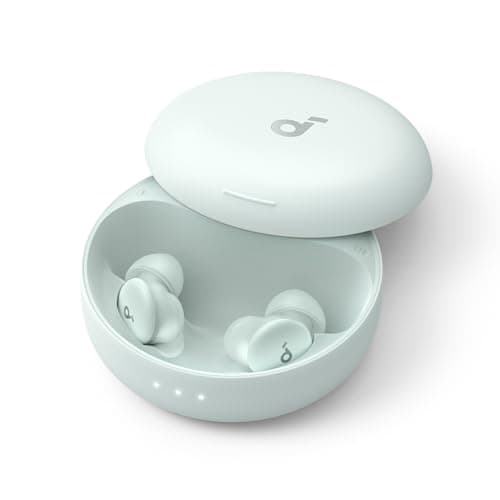 Soundcore Sleep A30The first sleep earbud with active noise cancellation, tuned for the low-frequency rumble that passive isolation cannot touch. | A snoring partner, specifically | Active noise cancellation with adaptive snore masking | |
| 2 | 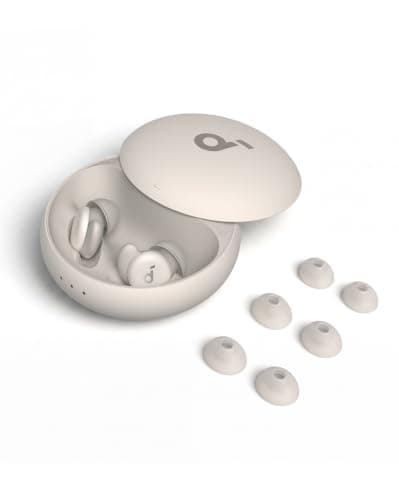 Soundcore Sleep A20Low-profile buds designed to be lain on, with the battery life to actually cover a full night plus a nap. | The value pick in sleep earbuds | 30 dB high-frequency passive noise reduction, 14 h per charge | |
| 3 | 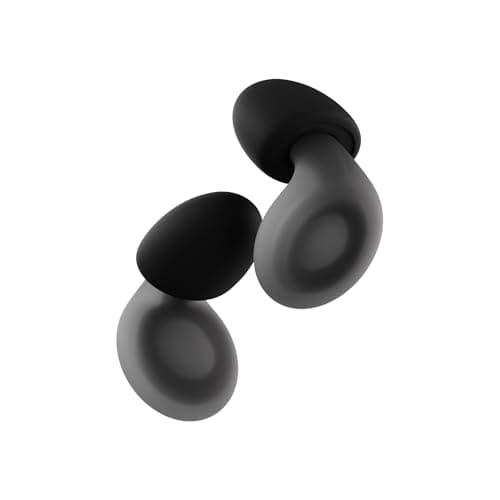 Loop DreamThe only plug here designed from scratch for bedtime rather than adapted to it - Loop's softest silicone, oval memory-foam tips and four tip sizes to get the seal right. | Side sleepers who want one plug and no compromises | 21 dB NRR / 27 dB SNR in a body shaped to be slept on | |
| 4 | 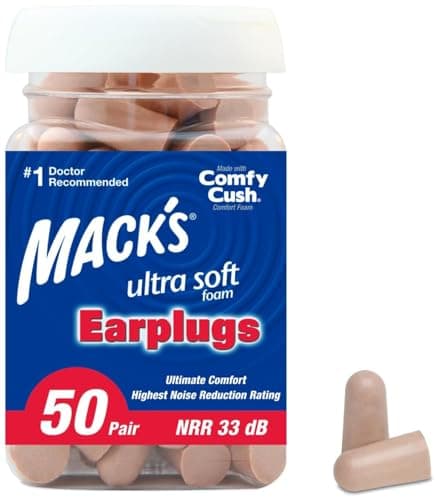 Mack's Ultra Soft Foam EarplugsThe highest-rated foam plug in common retail, at a price where losing one in the sheets does not matter. | Maximum blocking for the least money | NRR 33 dB - the highest rating in this roundup |
Prices come straight from Amazon and are refreshed daily; the date they were checked is stamped under the buy buttons below. If a price has gone stale or a listing has no offer, the button falls back to “Check price on Amazon” rather than showing a number we cannot stand behind. As an Amazon Associate we earn from qualifying purchases.
One genuinely active pick, one passive-plus-masking pick, and two passive plugs that outperform most things marketed as cancellation. Specifications are the manufacturers' own; we have tested none of these.
#ad How we are funded · price as of November 12, 2026
Our top pick · A snoring partner, specifically
1. Soundcore Sleep A30
The first sleep earbud with active noise cancellation, tuned for the low-frequency rumble that passive isolation cannot touch.
- Noise reduction:
- Active noise cancellation plus passive isolation
- Snore masking:
- Adaptive - responds to detected snoring
- Profile:
- Low-profile, side-sleeper oriented
- App:
- Yes, with sleep tracking
What it gets right
- ANC targets the low frequencies foam plugs and passive buds both struggle with
- Adaptive masking means the volume is not held constant all night
- Undercuts the premium sleep-bud competition on price
Where it falls short
- Expensive next to passive buds and an order of magnitude dearer than earplugs
- ANC draws power, so battery life is shorter than the A20
- Feature depth you will never use if all you want is quiet
Skip it if: Your noise is high-frequency - traffic, chatter, a TV next door. Passive blocking handles that for far less.
#ad How we are funded · price as of November 12, 2026
Pick 2 · The value pick in sleep earbuds
2. Soundcore Sleep A20
Low-profile buds designed to be lain on, with the battery life to actually cover a full night plus a nap.
- Noise reduction:
- 30 dB high-frequency, passive (manufacturer figure)
- Battery:
- 14 h per charge, 80 h total with the case
- Profile:
- Low-profile shell with ear wings, built for side sleeping
- Bluetooth:
- 5.3 - streams any audio source
What it gets right
- Passive isolation plus masking audio is a stronger combination than either alone
- Battery outlasts the night, which most true-wireless buds do not
- Streams anything, so you are not locked into one app's sound library
Where it falls short
- No active noise cancellation - that is the A30
- Passive isolation is weakest exactly where snoring lives, in the low frequencies
- Anything in your ear canal all night is a hygiene commitment
Skip it if: You just want silence. Earplugs block more, cost a fraction, and never need charging.
#ad How we are funded · price as of November 12, 2026
Pick 3 · Side sleepers who want one plug and no compromises
3. Loop Dream
The only plug here designed from scratch for bedtime rather than adapted to it - Loop's softest silicone, oval memory-foam tips and four tip sizes to get the seal right.
- Rating:
- 21 dB NRR, 27 dB SNR (manufacturer figures)
- Material:
- Soft silicone body, foam-silicone hybrid tips
- Fit:
- Four tip sizes XS-L, plus four Double Tip sizes
- Care:
- Reusable; tips are a consumable and get replaced
What it gets right
- Low-profile body in Loop's softest compound - the pressure point most side sleepers complain about is the one thing it was designed around
- Oval memory-foam tips expand into the ear canal rather than pushing back against it
- Eight tip pieces in the box, which is the difference between a plug that seals and one that falls out
Where it falls short
- The most expensive plug on this page by a wide margin
- 21 dB NRR is low - a foam plug blocks meaningfully more, and T3's reviewer notes this is passive muffling with no active cancellation
- Memory-foam tips are a recurring cost once they stop recovering their shape
Skip it if: You want maximum blocking for the least money. A foam plug beats it on raw attenuation for a few dollars.
#ad How we are funded · price as of November 12, 2026
Pick 4 · Maximum blocking for the least money
4. Mack's Ultra Soft Foam Earplugs
The highest-rated foam plug in common retail, at a price where losing one in the sheets does not matter.
- Rating:
- NRR 33 dB (manufacturer figure)
- Material:
- Slow-recovery polyurethane foam
- Reuse:
- A few nights each, then discard
- Sold as:
- Bulk packs
What it gets right
- Nothing in common retail blocks more
- Cheap enough to replace constantly, which is also more hygienic
- The soft compound is tolerable for side sleepers once compressed correctly
Where it falls short
- Only works if you roll and insert them properly - most complaints are fit, not product
- Disposable, so there is an ongoing cost and ongoing waste
- At 33 dB you will very likely sleep through a standard alarm
Skip it if: You have to hear an alarm, a child, or a smoke detector. This is the wrong tool for that night.
Questions people actually ask
Do noise canceling earplugs for sleeping actually exist?
Genuine active cancellation for sleep exists, but it comes as a rechargeable earbud rather than a plug - the Soundcore Sleep A30 is the mainstream example. Products sold as canceling earplugs are nearly always passive: a physical seal that absorbs sound. If it does not need charging, it is not canceling anything.
Are noise canceling earbuds better than earplugs for sleeping?
Only for low-frequency noise. Active cancellation handles steady rumble, which is where passive plugs are weakest, and that makes it the right answer for a snoring partner. For traffic, voices or a television through a wall, a 33 dB foam plug costs a fraction and blocks more.
What blocks snoring better, foam earplugs or ANC earbuds?
ANC earbuds, in principle, because snoring is dominated by the low frequencies passive foam struggles with - Johns Hopkins researchers measured snoring as a real noise exposure in a 2020 study in Sleep. Improving passive low-frequency attenuation is still an open engineering problem. Foam remains better value for everything else.
How do I tell if an earplug really has noise cancellation?
Check for a battery. Active cancellation needs power, so no battery means no cancellation. Then look for an NRR or SNR figure: those are passive attenuation ratings and their presence tells you the product is passive. A vague 'up to X dB' claim with no standard named is marketing, not a specification.
Is it safe to sleep with noise canceling earbuds in every night?
The cancellation itself is not the issue; the volume and the duration are. The WHO's safe listening guidance is built around level and duration together, and a full night is a long duration, so keep any masking audio as quiet as will do the job. Anything worn in the canal nightly is also a hygiene commitment.
Will noise canceling earbuds stop me hearing my alarm?
They can, and the risk is higher than with plugs because the bud is both sealing and playing sound. Most sleep earbuds include their own alarm that plays through the buds, which is the sensible way to solve it. A light-based or vibrating alarm is the belt-and-braces answer.
Sources
- Anker soundcore - Sleep A30 sleeping earbuds (manufacturer specifications: active noise cancellation, three-stage snore masking, 9 h per charge).
- Anker soundcore - Sleep A20 sleeping earbuds (manufacturer specifications).
- Loop - Dream earplugs for sleeping (manufacturer specifications).
- T3 - Loop Dream review: super soft earplugs to help you snooze soundly, even if you are a side sleeper.
- Mack's - Ear Plugs for Sleeping (manufacturer specifications).
- Carillo K, Sgard F, Dazel O, Doutres O. Improving low-frequency attenuation of passive earplugs using Helmholtz resonators. Journal of the Acoustical Society of America (IRSST record).
- Sowho M, Sgambati F, Guzman M, Schneider H, Schwartz A. Snoring: a source of noise pollution and sleep apnea predictor. Sleep, 2020;43(6):zsz305 (Johns Hopkins School of Medicine).
- World Health Organization - Making Listening Safe (safe listening levels and duration).
Back to the best white noise machines.
Read next
- Best sleep earbudsThe full earbud category, ranked.Read it
- Soundcore Sleep A20 vs A30Passive against active, in the same product family.Read it
- Best earplugs for sleepingWhat to buy when passive blocking is the right tool.Read it
- Earplugs for snoringThe low-frequency problem, approached passively.Read it
 Best earplugs for sleeping that don't hurtIf the comfort of the thing in your ear is the blocker.Read it