
How this page is funded: we earn a commission if you buy through the links below, at no extra cost to you. As an Amazon Associate we earn from qualifying purchases. It does not change which products we pick or the order they appear in. Full disclosure.
How these picks were made: by comparing published specifications and clearly-credited public reporting. We do not run a laboratory, we have not measured these products, and we do not claim to have slept with them. Here is exactly how we choose.
Almost every weighted blanket sold is built for an adult, and the most common mistake parents make is scaling an adult recommendation down by eye. The rules below come first. The products come after, and only two of the blankets we cover make weights we would put on a child at all.
The rules, before anything else
- Never for a baby. Weighted blankets, weighted swaddles and weighted sleep sacks have no place in a crib. Safe-sleep guidance for infants under 12 months is no loose blankets, no soft objects and no weighted bedding, and that is not a rule with exceptions.
- Not for toddlers. Common pediatric guidance puts the floor at around age three at the absolute earliest, and much of it suggests waiting considerably longer. The functional test matters more than the birthday: the child must be able to push the blanket off themselves, without help, and tell you if they are uncomfortable.
- About ten percent of the child’s body weight. This is the figure pediatric occupational therapists commonly use as a starting point, give or take a pound or two. For a 50 lb child that is roughly 5 lb. Never round up.
- Never over the head or face. A weighted blanket covers the body from the shoulders down. This is worth saying out loud to the child.
- Check the seams, monthly. A split baffle on a glass-bead blanket is a spill of small hard beads in a child’s bed. Small quilted pockets and double stitching are the features to pay for here.
If a child has any medical condition affecting breathing, movement, circulation or the ability to reposition themselves, ask their clinician before buying a weighted blanket at all. We do not give medical advice and we are not going to start on a page about children.
Why the popular adult picks fail here
Two reasons. First, weight: most of the well-reviewed adult blankets start at 12 or 15 lb, which is far too heavy for any child the ten percent rule applies to. Second, size: an adult blanket on a child’s bed is mostly overhang, and overhang is both a tangle risk and the reason the blanket ends up on the floor by midnight.
That is why the shortlist above is short. The two picks are there because they make genuinely child-sized weights and dimensions, not because they are the best blankets in the category overall.
Weight by child body weight
| Child’s weight | Blanket weight (roughly 10%) | Note |
|---|---|---|
| Under 30 lb | Do not use | Too young and too light for this category |
| 30 - 40 lb | 3 - 4 lb | Only if the child can remove it unaided |
| 40 - 60 lb | 4 - 6 lb | The most common pediatric range |
| 60 - 80 lb | 6 - 8 lb | Round down between sizes |
| 80 - 100 lb | 8 - 10 lb | Approaching the smallest adult sizes |
The same arithmetic, with the adult bands and the between-sizes rule, is on the weight guide.
If the reason you are shopping is a sensory profile rather than a bedtime preference, we wrote a separate page for autism and ADHD - including what the one randomized trial in autistic children actually found, which is more complicated than the product pitch.
What else actually helps a child sleep
Weight is one lever and it is not usually the first one. A dark room and a consistent sound floor do more for most children than a blanket does. A sound machine is the single most common purchase parents keep using, and if the problem is a bright summer evening or a streetlight, that is a light problem rather than a bedding one.
If a blanket is going to be on a bed every night rather than used occasionally, the specification you should be shopping for changes - can you use a weighted blanket every night covers breathability, covers and the weight error worth making.
If the problem in that room is light rather than weight, the same removal rule applies to masks - sleep masks for kids leads with the age rules before any product.
The two blankets that make genuinely child-sized weights
Tap any row to jump to the full write-up. Each thumbnail is the product photograph from that item’s own Amazon listing, and the price in the last column is the one Amazon showed at the last check.
| # | Product | Best for | The spec that decides it | Price |
|---|---|---|---|---|
| 1 | 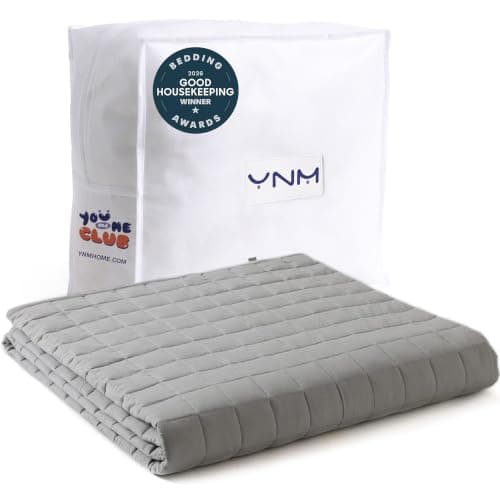 YnM Weighted BlanketThe sizing catalog, not the luxury pick: glass beads in small quilted pockets, in weights and dimensions from child up to king. | Odd sizes and weights nobody else makes | 2 x 2 in compartments - the smallest pockets in the category | |
| 2 | 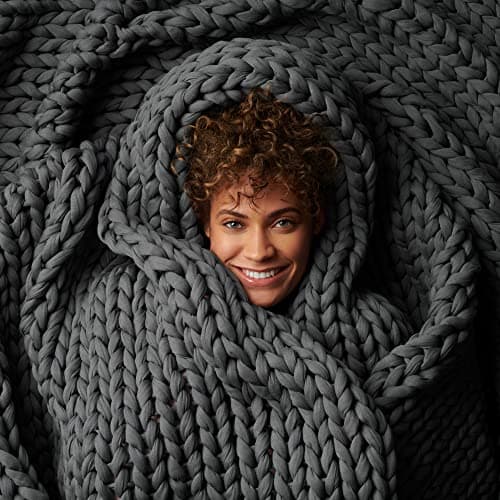 Bearaby Cotton NapperThe only mainstream weighted blanket with no beads at all - the weight is the yarn itself, so air moves straight through the knit. | Anyone who hates the sealed-duvet feeling | Bead-free: weight comes from organic cotton yarn |
Prices come straight from Amazon and are refreshed daily; the date they were checked is stamped under the buy buttons below. If a price has gone stale or a listing has no offer, the button falls back to “Check price on Amazon” rather than showing a number we cannot stand behind. As an Amazon Associate we earn from qualifying purchases.
#ad How we are funded · price as of November 12, 2026
Our top pick · Odd sizes and weights nobody else makes
1. YnM Weighted Blanket
The sizing catalog, not the luxury pick: glass beads in small quilted pockets, in weights and dimensions from child up to king.
- Fill:
- Glass beads in 2 x 2 in compartments, the smallest YnM makes
- Construction:
- 7-layer system, with 16 loops for a duvet cover
- Sizing:
- Maker's rule: 10% of body weight plus 1 lb; 80 x 87 in or larger to share
- Care:
- Machine wash gentle, tumble dry low or line dry
What it gets right
- More weight-and-size combinations than anyone else, which matters if the ten percent rule lands you on an unusual number
- 2 x 2 in pockets keep beads distributed better than large-baffle designs
- Consistently the cheapest way into a proper glass-bead blanket
Where it falls short
- Shell fabric quality is the trade-off for the price
- Runs warm compared with cotton-knit options
- The duvet cover the 16 loops are for is sold separately
Skip it if: You are a hot sleeper. This is a warm blanket and no cover fixes that.
#ad How we are funded · price as of November 12, 2026
Pick 2 · Anyone who hates the sealed-duvet feeling
2. Bearaby Cotton Napper
The only mainstream weighted blanket with no beads at all - the weight is the yarn itself, so air moves straight through the knit.
- Fill:
- None - weight is long-staple organic cotton yarn
- Weights:
- 10, 15, 20, 25 lb (manufacturer's published ladder)
- Construction:
- Open hand-knit weave
- Care:
- Machine washable
What it gets right
- No beads means no shifting, no bunching and no rustling
- The open knit breathes better than any quilted shell in this roundup
- Doubles as a sofa throw without looking like medical equipment
Where it falls short
- Among the most expensive options in the category
- The open weave catches on rings, watches and rough pet claws
- Heavy knit takes a long time to dry
Skip it if: You want the tucked-in, evenly pinned feeling a bead blanket gives. The knit drapes; it does not press.
Questions people actually ask
At what age can a child use a weighted blanket?
Not as a baby, under any circumstances - safe-sleep guidance for infants under 12 months rules out weighted bedding entirely. Common pediatric guidance puts the earliest floor at around age three, and much of it suggests waiting longer. The practical test is whether the child can push the blanket off themselves without help and tell you if they are uncomfortable.
How heavy should a kid's weighted blanket be?
About ten percent of the child's body weight, plus or minus a pound or two - the figure pediatric occupational therapists commonly use as a starting point. For a 50 lb child that is roughly 5 lb. Always round down rather than up.
Are weighted blankets safe for children?
For a child old enough to remove the blanket unaided and communicate discomfort, and at roughly ten percent of their body weight, they are widely used. The risks come from the exceptions: too young, too heavy, covering the head, or a split seam releasing glass beads. If a child has any condition affecting breathing, movement or repositioning, ask their clinician first.
Can two children share a weighted blanket?
No. A weighted blanket is sized to one body at roughly ten percent of that body's weight, and a blanket correct for one child is wrong for the other. Shared weighted bedding also makes it harder for either child to get out from under it.
Can a weighted blanket be washed if a child has an accident?
Glass-bead blankets are usually machine washable cold on a gentle cycle, but a soaked child's blanket is still heavy and a domestic machine may struggle. A washable duvet cover is the practical answer for anyone buying this for a child.
Sources
- Gillette Children's - Weighted Blankets patient education (pediatric weight guidance).
- Sleep Foundation - Best Weighted Blankets (specification comparison).
- Ekholm B, Spulber S, Adler M. A randomized controlled study of weighted chain blankets for insomnia in psychiatric disorders. Journal of Clinical Sleep Medicine, 2020.
Back to the best weighted blankets.
Read next
- How heavy should a weighted blanket be?The full chart, adult and child bands.Read it
 How to wash a weighted blanketThe question every parent has within three weeks.Read it
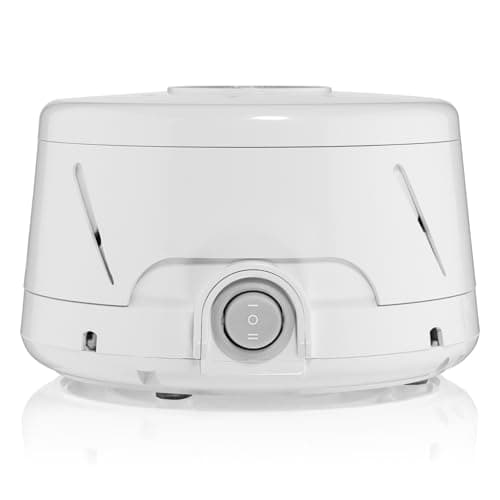 Best white noise machinesThe purchase parents actually keep using.Read it
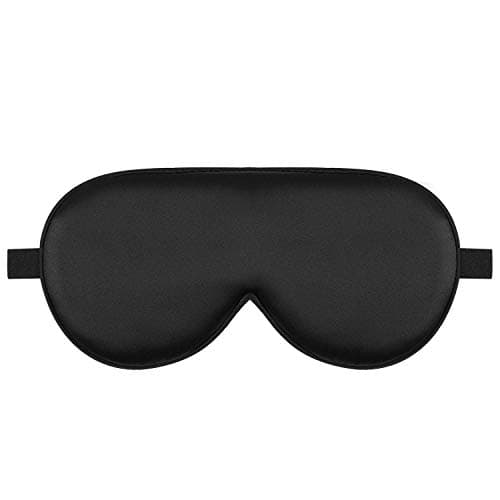 How to make a bedroom dark for sleepingFor summer evenings and streetlight through the blinds.Read it
- Best weighted blankets for teensThe weight band between a child and an adult.Read it
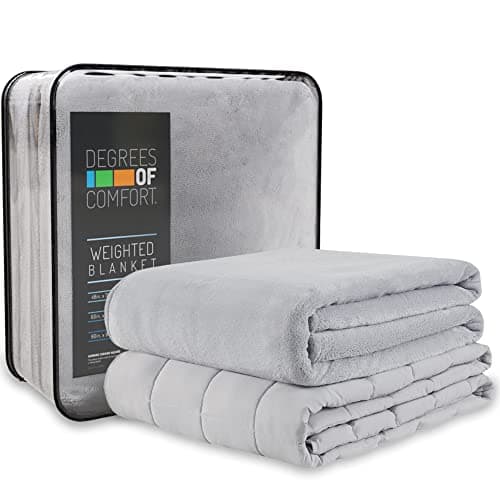 Best weighted blankets with a washable coverThe laundry problem, solved properly.Read it