
How this page is funded: we earn a commission if you buy through the links below, at no extra cost to you. As an Amazon Associate we earn from qualifying purchases. It does not change which products we pick or the order they appear in. Full disclosure.
How these picks were made: by comparing published specifications and clearly-credited public reporting. We do not run a laboratory, we have not measured these products, and we do not claim to have slept with them. Here is exactly how we choose.
There is a difference between a mask that makes the room dimmer and a mask that makes it dark. For sleeping at night in a normal bedroom, dimmer is usually enough. For sleeping during the day, or in a room with a streetlight outside, it is not - and the gap between those two standards is what this page is about.
What blackout actually requires
Three things have to be true at once, and most masks manage two:
- Opaque material. The easy part. Almost every mask sold is opaque enough; light does not come through the fabric.
- A seal at the nose bridge. The hard part, and where nearly all failure happens. The triangle either side of your nose is an escape route that fabric opacity does nothing about.
- A seal at the temples and cheekbones. Where narrow masks leak and oversized ones do not.
The nose bridge, properly
If you see a glow at the bottom edge of your vision when you have a mask on, that is the nose gap. Faces vary enormously here - bridge height, width and the angle where the nose meets the cheek - and a fixed-shape mask is designed around an average of those. If your face is not the average, the mask leaks.
The three genuine fixes, in ascending order of cost:
- A nose flap or wire. A small fabric extension or a bendable wire that conforms to your bridge. The cheapest real solution.
- Deeper cups that extend inwards. Contoured masks that carry their molding further towards the center close the gap by geometry.
- Independently repositionable cups. The modular approach: you physically move each cup until it seals on your face. It is the only design that adapts to the face rather than expecting the face to match it, and it is why our top pick is the top pick.
The trade-off is real and unavoidable
The three masks above are the best blackout we found, and all three are among the least comfortable to lie on. That is not a coincidence - it is the same physics twice. Blackout comes from depth and from pressing firmly against the bone around the eye, and both of those are exactly what makes a mask unpleasant when a pillow pushes it back into your face.
So be honest about which you need. If you sleep on your side, the side-sleeper roundup is the right page and you should accept slightly less blackout for a mask you will actually keep wearing. A brilliant mask in a drawer blocks nothing.
Do the room as well
A mask is a patch, and it is a very good one - but if you need genuine darkness, fixing the room means the mask does not have to be perfect. That is the combination that works for day sleepers: blackout the room so the mask only has to catch what is left.
It matters because of the numbers. The 2022 PLOS Biology consensus recommendations suggest under about 1 melanopic lux at the eye during sleep, and Harvard Health notes circadian effects at around 8 lux - dimmer than most table lamps. A room you think is dark is usually well above both. How to make a bedroom dark for sleeping is the free half of this, and the mask-versus-curtains comparison covers which to spend on first.
If you sleep during the day
You have the hardest version of this problem, because daylight through a domestic curtain is enormously brighter than anything at night, and it arrives from every direction. The realistic setup is all three layers: room blackout, a genuinely sealing mask, and the noise handled separately, since the world is awake while you are not. The night-shift mask roundup is written specifically for that.
Three masks that get genuinely close to total darkness
Tap any row to jump to the full write-up. The photographs are licensed stock images chosen to illustrate the category - they are not photographs of these specific products, and each one’s alt text describes what is actually shown.
| # | Product | Best for | The spec that decides it | Price |
|---|---|---|---|---|
| 1 | 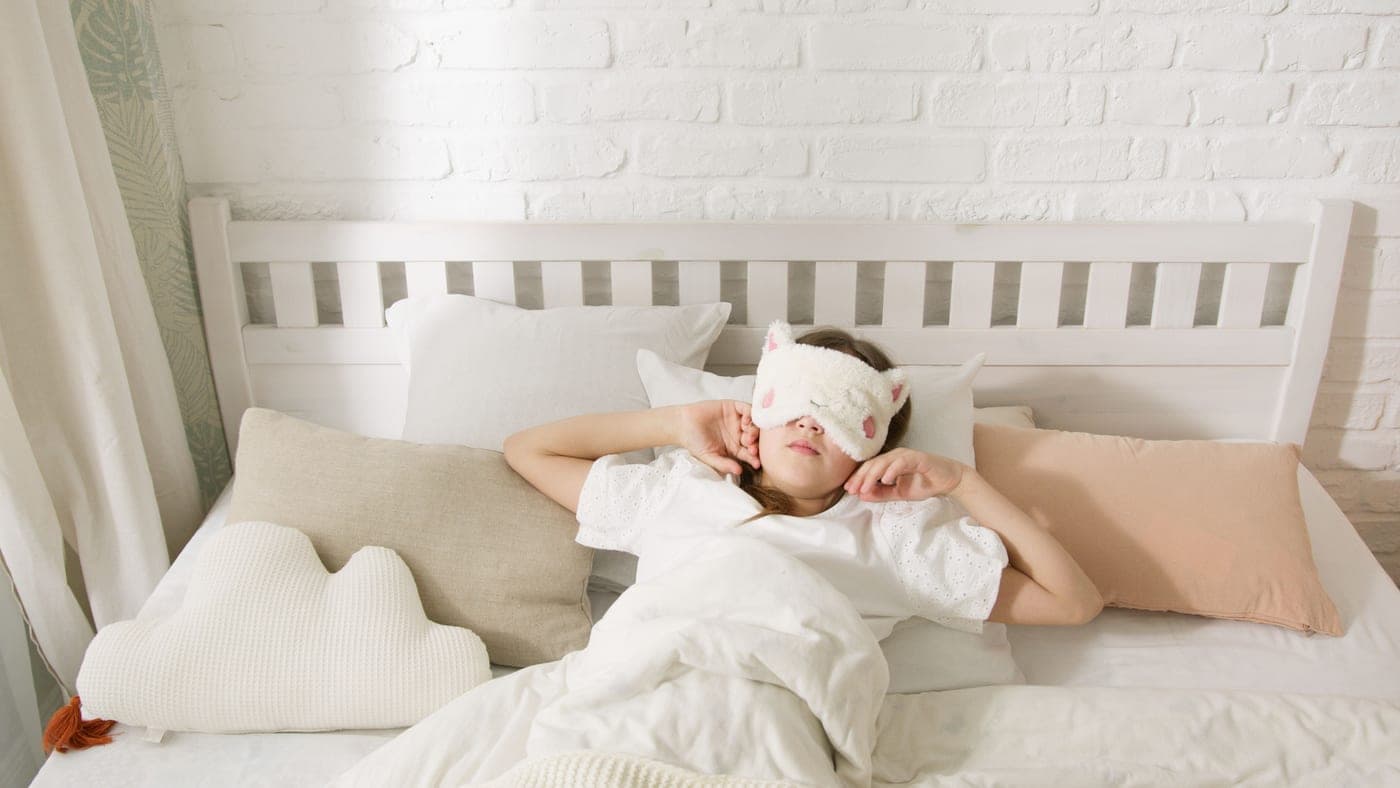 Manta Sleep Mask ProThe most adjustable mask in the category: the eye cups move independently, so you can seal a nose bridge that defeats every one-piece mask. | Total blackout on a back sleeper | Independently repositionable eye cups, zero eye pressure | |
| 2 |  Tempur-Pedic Sleep MaskBlocks light as well as anything here by molding tightly to the face - which is also exactly why some people cannot wear it. | Sealing light out at all costs | Tempur memory foam molded to the face | |
| 3 |  MZOO Sleep MaskA contoured memory-foam mask at commodity pricing. The blackout is solid; the side panels are the thickest here. | Blackout on a budget | 3D contoured foam with roughly 35 mm side panels |
We have no live price feed for this site yet, so every button reads “Check price on Amazon” rather than showing a number that could be out of date. As an Amazon Associate we earn from qualifying purchases.
Our top pick · Total blackout on a back sleeper
1. Manta Sleep Mask Pro
The most adjustable mask in the category: the eye cups move independently, so you can seal a nose bridge that defeats every one-piece mask.
- Construction:
- Modular cups on a hook-and-loop band
- Eye pressure:
- None - the cups arch over the eye socket
- Adjustment:
- Cups reposition horizontally to match your face
- Strap:
- Wide adjustable band
What it gets right
- Seals light at the nose bridge better than any fixed-shape mask once fitted
- No contact with the eyelid, so you can blink freely and sleep in contacts
- Cups and band are replaceable, so the mask outlives its fabric
Where it falls short
- The deepest profile here - the cups stand well off the face
- Fitting it correctly takes a few nights of adjustment
- Premium price
Skip it if: You sleep strictly on your side. The cups press into the pillow and then into your face.
Pick 2 · Sealing light out at all costs
2. Tempur-Pedic Sleep Mask
Blocks light as well as anything here by molding tightly to the face - which is also exactly why some people cannot wear it.
- Material:
- Tempur memory foam
- Fit:
- Conforms closely to facial contours
- Blackout:
- Among the strongest we shortlisted
- Strap:
- Adjustable
What it gets right
- Genuinely excellent light sealing along the nose and cheekbones
- The foam does not lose its shape the way cheap foam does
- Brand-backed quality control
Where it falls short
- Comfort is the recurring complaint in public reporting - it is a tight mask
- Dense foam traps facial heat
- Not a packable travel mask
Skip it if: You dislike anything pressing on your face. This mask works by pressing on your face.
Pick 3 · Blackout on a budget
3. MZOO Sleep Mask
A contoured memory-foam mask at commodity pricing. The blackout is solid; the side panels are the thickest here.
- Construction:
- 3D contoured memory foam
- Side panels:
- Around 35 mm - among the bulkiest
- Eye pressure:
- None - the eye cavities clear the lashes
- Strap:
- Adjustable buckle
What it gets right
- Blackout performance close to masks costing several times more
- Eye cavities mean no pressure on the eyeball
- Widely stocked and easy to replace
Where it falls short
- Thick side panels are the trade-off for that blackout
- Foam holds heat against the face
- Fabric and buckle quality track the price
Skip it if: You sleep on your side or run hot in the face. The panels press and the foam warms.
Questions people actually ask
What is the best blackout sleep mask?
A modular mask with independently repositionable cups gets closest to total darkness, because it adapts to your face rather than expecting your face to match an average. Dense molded foam masks come close and seal well at the cheekbones. All of them are deep, which is the comfort trade-off.
Why can I still see light with a blackout mask on?
Almost certainly the nose bridge - the triangle either side of your nose, where fixed-shape masks assume an average bridge height. A nose flap or wire, deeper inward-extending cups, or adjustable modular cups are the three real fixes.
Can a sleep mask give total darkness?
Very close, with a well-fitted modular or dense contoured mask. Absolute darkness is easier to reach by combining a good mask with a darkened room, which also means the mask does not have to be perfect to work.
Are blackout masks uncomfortable?
The best ones generally are, and it is the same physics twice: blackout comes from depth and from pressing firmly against the bone around the eye, which is exactly what a pillow then pushes back into your face. Side sleepers should trade some blackout for a mask they will keep wearing.
How dark does a bedroom need to be?
The 2022 PLOS Biology consensus recommendations suggest under about 1 melanopic lux at the eye during sleep. Harvard Health notes measurable circadian effects at around 8 lux, which is dimmer than most table lamps - so a room that feels dark is usually well above the target.
Sources
- Brown TM et al. Recommendations for daytime, evening and nighttime indoor light exposure to best support physiology, sleep and wakefulness in healthy adults. PLOS Biology, 2022.
- Harvard Health Publishing - Blue light has a dark side.
- TechGearLab - The Best Sleep Mask, tested and ranked.
- Reviewed - The Best Sleep Masks.
Back to the best sleep masks.
Read next
- How to make a bedroom dark for sleepingThe free half of the blackout problem.Read it
- Sleep mask vs blackout curtainsWhich to spend on first, and why.Read it
- Best sleep masks for night shift workersThe hardest version of this problem.Read it
- Best sleep masks for side sleepersIf the best blackout masks are unbearable to lie on.Read it