
How this page is funded: we earn a commission if you buy through the links below, at no extra cost to you. As an Amazon Associate we earn from qualifying purchases. It does not change which products we pick or the order they appear in. Full disclosure.
How these picks were made: by comparing published specifications and clearly-credited public reporting. We do not run a laboratory, we have not measured these products, and we do not claim to have slept with them. Here is exactly how we choose.
Short answer: the real side effects are a short list and nearly all of them trace back to two purchase decisions - a blanket that is too heavy, or a blanket made of the wrong material. Overheating, a feeling of chest pressure, pins and needles in an arm, and simply sleeping worse are the four things people genuinely report. Long-term harm, dependency and damage to your circulation are not supported by anything we can cite. The genuine safety rule is about who should not use one at all, not about what happens if you do.
We should set expectations on what kind of page this is. We are a gear site; we have no clinicians and this is not medical advice. What we can do is separate the mechanical and material problems - which are ours to talk about, because they are properties of products - from the medical questions, which belong with a doctor. If you have not bought one yet, the prior question is on are weighted blankets worth it; nightly use is covered on can you use a weighted blanket every night.
The four that are real
Overheating. By a wide margin the most common complaint, and it is a materials problem rather than a weight problem. A quilted polyester shell with a minky backing is two layers of fabric plus fill sitting on you, and it traps the heat you are trying to shed. The evidence that heat matters to sleep onset is solid - the mechanism is reviewed in Harding, Franks and Wisden’s overview of sleep and thermoregulation - and the fix is an open knit or a cotton shell and liner. The cooling roundup exists for this.
A feeling of pressure on the chest. Real, mechanical, and the reason weight choice is not a preference. If you notice the blanket when you breathe, it is too heavy for you. The usual rule of thumb is about ten percent of body weight - Degrees of Comfort suggests 10 to 14 percent for its own range - and the weight guide is the page for this. If you have a respiratory condition, including sleep apnea, that is a conversation with a clinician before you buy, not after.
Numbness or pins and needles in a limb. Usually means the fill has pooled into one area and is concentrating weight on an arm or a shoulder, which is a construction failure rather than an inherent property. Double-stitched baffles are the fix, and a blanket that has started pooling after a year of washing is telling you something about its baffles - the bead and fill page goes into why.
Sleeping worse, not better. The one nobody lists and plenty of people experience. A blanket you fight, or that makes turning over an effort, costs you more than the pressure gives back. If this is you, go lighter before you give up on the category.
What we cannot find support for
| Claim | Our read |
|---|---|
| “Long-term side effects” | No mechanism and no evidence. A blanket is a blanket that weighs more |
| Dependency or tolerance | Habituation to a sensation is real; physiological dependence is not |
| Damaging your circulation | Nothing to cite. Numbness is pooled fill, which is a fixable fit problem |
| Weight loss or metabolic effects | No. This appears in searches and has no basis we can find |
| Worsening anxiety | Not as a physiological effect, though claustrophobic discomfort is real and reason enough not to use one |
It is also worth being straight that the benefit side of the ledger is thinner than the marketing suggests, which cuts both ways. The 2020 JCSM randomized trial found a reduction in insomnia severity in a specific clinical population, while Gringras and colleagues’ 2014 Pediatrics trial found no sleep improvement in autistic children and the hospital behind it said so publicly. A product with modest evidence of benefit and almost no evidence of harm is a reasonable thing to try and a bad thing to oversell.
The one genuine safety rule
Everything above is about discomfort. This is the part that is about safety, and it is the same principle every responsible source states: a weighted blanket must never be used by anyone who cannot remove it themselves.
That rules out infants and toddlers absolutely, and it applies to anyone with significant mobility limitation or reduced awareness overnight. For children generally, pediatric weight guidance is stricter and lighter than adult rules of thumb - Gillette Children’s patient education is the sort of source to work from, and our weighted blankets for kids page and the teens page both treat it as a weight question rather than a style question.
Two medical cases also belong with a clinician rather than with us: any respiratory or circulatory condition where chest pressure could matter, and pregnancy, where we would not offer a view at all. That is not a dodge - it is what the limits of a gear site look like.
Fixing a blanket you already own
Before you replace it, three things resolve most complaints.
If you are hot, change the cover, not the blanket. Swapping a minky duvet cover for a cotton or linen one is cheap and does more than people expect - the cover is the layer touching you. A removable cover is also the thing that makes nightly washing realistic, which is the argument of the washable-cover page.
If the weight is on your chest, move the blanket down. Weighted blankets do not have to cover you to the shoulders. Starting at the waist keeps the pressure on your legs and hips, where almost nobody minds it.
If the fill has pooled, redistribute it and check the stitching. Lay the blanket flat and work the fill back into its pockets. If it pools again within a week, the baffles have failed and the honest answer is a better-built blanket - which is what the brand comparison is for. Everything else in the category sits on the weighted blanket hub.
Blankets that avoid the three common causes
Tap any row to jump to the full write-up. Each thumbnail is the product photograph from that item’s own Amazon listing, and the price in the last column is the one Amazon showed at the last check.
| # | Product | Best for | The spec that decides it | Price |
|---|---|---|---|---|
| 1 | 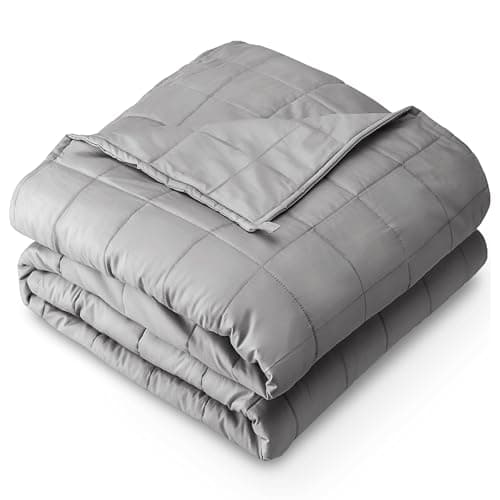 Bare Home Cotton Weighted BlanketAll-natural cotton and nontoxic glass beads in small reinforced pockets - the cheapest way to get a cotton shell instead of a polyester one. | A cotton bead blanket without the premium price | All-natural 100% cotton shell, nontoxic glass-bead fill, 15 lb at 48 x 72 in | |
| 2 | 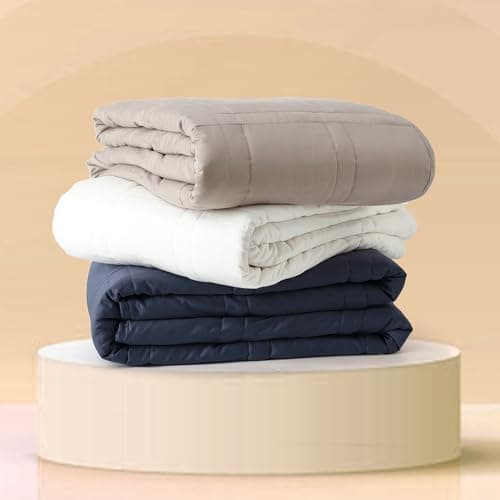 Baloo Living Weighted BlanketA conventional glass-bead blanket done carefully: 100% cotton shell and liner, and double-stitched baffles so the beads stay where they were put. | A cotton bead blanket that does not run hot | Glass microbeads in a 100% cotton shell and liner | |
| 3 | 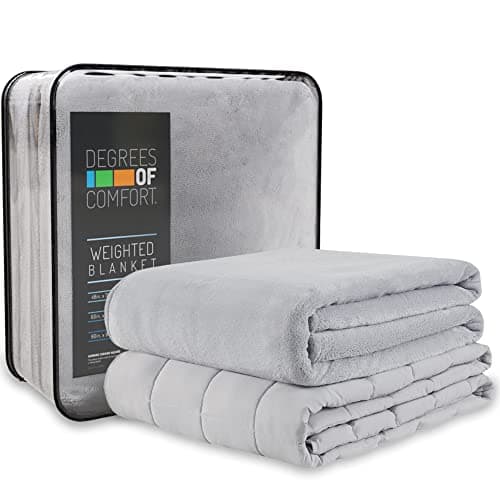 Degrees of Comfort Weighted Blanket with CoverThe blanket that solves the laundry problem out of the box: a minky plush cover arrives pre-assembled on it, comes off, and goes in the machine on its own. | A washable cover included in the box | Cozyheat minky plush cover included, 7-layer build, 12 lb at 48 x 72 in |
Prices come straight from Amazon and are refreshed daily; the date they were checked is stamped under the buy buttons below. If a price has gone stale or a listing has no offer, the button falls back to “Check price on Amazon” rather than showing a number we cannot stand behind. As an Amazon Associate we earn from qualifying purchases.
Chosen for a breathable shell, a sensible weight ladder and a washable cover - the three features that prevent most of what gets reported as a side effect. Specifications are the manufacturers' own.
#ad How we are funded · price as of November 12, 2026
Our top pick · A cotton bead blanket without the premium price
1. Bare Home Cotton Weighted Blanket
All-natural cotton and nontoxic glass beads in small reinforced pockets - the cheapest way to get a cotton shell instead of a polyester one.
- Fill:
- Nontoxic glass beads in small pockets
- Shell:
- All-natural 100% cotton
- Size:
- 48 x 72 in, 15 lb - the maker's 10%-of-body-weight pick for a 150 lb adult
- Cover:
- None included; Bare Home sells a matching duvet cover separately
- Care:
- Machine wash cold on gentle, hang or air dry; 30-night trial
What it gets right
- A cotton shell rather than polyester, so it does not trap heat the way minky does
- Reinforced stitching and smaller pockets, which is what stops beads pooling at the foot
- A 30-night sleep-on-it window, unusual at this price
Where it falls short
- No removable cover - you buy that separately
- The bare cotton shell is plain to look at
- Hang-dry only, so laundry day takes longer than a tumble-dry blanket
Skip it if: You want the cover included in the box. The Degrees of Comfort blanket ships one with it.
#ad How we are funded · price as of November 12, 2026
Pick 2 · A cotton bead blanket that does not run hot
2. Baloo Living Weighted Blanket
A conventional glass-bead blanket done carefully: 100% cotton shell and liner, and double-stitched baffles so the beads stay where they were put.
- Fill:
- Mini glass beads
- Shell and liner:
- 100% cotton inside and out, OEKO-TEX Standard 100 certified
- Sizes:
- 9 lb mini, 12 lb throw (42 x 72 in), 15 and 20 lb full/queen
- Care:
- Machine washable and dryer safe - cold, gentle, low heat
What it gets right
- Cotton on both faces rather than a polyester minky backing - the maker's whole pitch
- The 12 lb throw concentrates its weight in a smaller area, so it feels denser than the number suggests
- Dryer safe, which almost nothing else in this roundup is
Where it falls short
- Cotton is breathable but a quilted shell still traps more heat than an open knit
- The throw is sofa-sized rather than bed-sized - you size up for a bed
- Bulky and slow to dry after washing
Skip it if: You run very hot. A quilted construction is still two layers of fabric plus fill, whatever the fiber.
#ad How we are funded · price as of November 12, 2026
Pick 3 · A washable cover included in the box
3. Degrees of Comfort Weighted Blanket with Cover
The blanket that solves the laundry problem out of the box: a minky plush cover arrives pre-assembled on it, comes off, and goes in the machine on its own.
- Fill:
- Premium glass beads in small pockets for even distribution
- Cover:
- One Cozyheat minky plush cover, pre-assembled in the package
- Size:
- 48 x 72 in twin, 12 lb
- Construction:
- 7 layers with Duralast fiber stitching
- Sizing:
- Maker suggests roughly 10% of body weight, plus or minus 1-2 lb
What it gets right
- The cover is included rather than an upsell, which is the whole reason to buy this one
- Small bead pockets keep the weight from migrating to the foot of the bed
- Works with the cover for winter and without it for a warm room, which is two blankets in one box
Where it falls short
- Getting a heavy blanket back into the cover is a two-person job
- The minky cover is warm - the maker itself says to take it off if you sleep hot
- One weight and one size on this listing, so there is no ladder to climb
Skip it if: You sleep hot and want to keep the cover on. A mink-feel polyester cover is the warmest surface in this category.
Questions people actually ask
What are the side effects of a weighted blanket?
Four things are genuinely reported: overheating, a feeling of pressure on the chest, numbness or pins and needles in a limb, and simply sleeping worse. Nearly all of them trace back to two purchase decisions - a blanket that is too heavy, or one made of the wrong material. None of them is a long-term harm.
Are there long-term side effects from using a weighted blanket?
We cannot find support for any, and there is no mechanism we would expect to produce one. It is a blanket that weighs more. The research base is thin on both sides of the ledger: one randomized trial found reduced insomnia severity in a clinical population, another found no sleep benefit in autistic children, and neither reported long-term harm.
Can a weighted blanket make it hard to breathe?
A blanket that is too heavy can feel like pressure on the chest, and if you notice it when you breathe, it is too heavy for you. The usual rule of thumb is around ten percent of body weight. If you have a respiratory condition, including sleep apnea, that is a conversation to have with a clinician before buying rather than a specification to pick.
Why does my arm go numb under a weighted blanket?
Usually because the fill has pooled into one area and is concentrating weight on your arm or shoulder. That is a construction failure rather than an inherent property of weighted blankets. Lay the blanket flat and work the fill back into its pockets; if it pools again within a week, the baffles have failed.
Who should not use a weighted blanket?
Anyone who cannot remove it themselves - which rules out infants and toddlers absolutely and applies to anyone with significant mobility limitation. Anyone with a respiratory or circulatory condition where chest pressure could matter should ask a clinician first. Children need pediatric weight guidance rather than adult rules of thumb.
Can a weighted blanket make anxiety worse?
Not as a physiological effect that we can find support for. What is real is that some people find the enclosed sensation uncomfortable or claustrophobic, and for them the blanket is simply the wrong product - that is reason enough not to use one, and not something to push through.
Sources
- Ekholm B, Spulber S, Adler M. A randomized controlled study of weighted chain blankets for insomnia in psychiatric disorders. Journal of Clinical Sleep Medicine, 2020.
- American Academy of Sleep Medicine - Study shows weighted blankets can decrease insomnia severity (2020).
- Gringras P, Green D, Wright B, et al. Weighted blankets and sleep in autistic children - a randomized controlled trial. Pediatrics, 2014;134(2):298-306 (PubMed 25022743).
- Guy's and St Thomas' NHS Foundation Trust - Heavy blankets do not help children with autism to sleep (plain-language summary from the hospital that ran the trial).
- Gillette Children's - Weighted Blankets patient education (pediatric weight guidance).
- Harding EC, Franks NP, Wisden W. Sleep and thermoregulation. Current Opinion in Physiology, 2020 (PMC7323637).
- Degrees of Comfort - washable weighted blanket with a removable Cozyheat minky cover (Amazon listing, specifications as published by the seller).
- Bare Home - Cotton Weighted Blanket (manufacturer specifications).
Back to the best weighted blankets.
Read next
- Can you use a weighted blanket every night?The nightly-use version of the same question.Read it
 Are weighted blankets worth it?The benefit side of the ledger, evidence first.Read it
 What weight weighted blanket do I need?The decision behind most reported side effects.Read it
- Best cooling weighted blanketsFixing the most common complaint of all.Read it
 Weighted blankets for kidsWhere the weight rules are stricter.Read it