
How this page is funded: we earn a commission if you buy through the links below, at no extra cost to you. As an Amazon Associate we earn from qualifying purchases. It does not change which products we pick or the order they appear in. Full disclosure.
How these picks were made: by comparing published specifications and clearly-credited public reporting. We do not run a laboratory, we have not measured these products, and we do not claim to have slept with them. Here is exactly how we choose.
Direct answer: there is one randomized controlled trial that most of this claim rests on, and it is genuinely positive - Ekholm and colleagues found that participants using a weighted chain blanket for four weeks had reduced insomnia severity compared with a control blanket. But read the population: the participants had insomnia alongside a diagnosed psychiatric condition, and the study is one trial rather than a body of evidence. A weighted blanket is a reasonable, low-risk thing to try for insomnia. It is not a treatment for it, and nobody on this site is qualified to tell you otherwise.
What the trial actually found
The study published in the Journal of Clinical Sleep Medicine in 2020 randomized adults with insomnia and a co-occurring psychiatric diagnosis to either a weighted chain blanket or a light control blanket for four weeks. The weighted group showed a significantly greater reduction in insomnia severity, along with better reported daytime symptoms. The American Academy of Sleep Medicine summarized it as a study showing weighted blankets can decrease insomnia severity.
Three qualifications that matter, and that most pages citing this study leave out.
- The population was specific. Insomnia plus a diagnosed psychiatric condition. Whether the effect transfers cleanly to insomnia on its own is not something this trial can tell you.
- Blinding is nearly impossible here. Participants know whether their blanket is heavy. That is not a flaw anyone could have designed around, but it does mean expectation plays a role.
- It is one trial. Weighted blanket research elsewhere has been mixed - in autistic children, for instance, a randomized trial reported by Gringras and colleagues found no objective sleep improvement, even though the children and families preferred the weighted blanket. That is exactly the shape of result that should make you cautious about strong claims in either direction.
Why it might work, in plain terms
The proposed mechanism is deep pressure stimulation: broad, even pressure across the body is associated with a shift toward a calmer autonomic state, in the same family of effects as swaddling or a firm hug. That is a plausible mechanism rather than a demonstrated chain of causation, and we are not going to dress it up with neurotransmitter names the evidence does not support.
What is well established is the thermal side. Core temperature has to fall for sleep onset - see Harding, Franks and Wisden on sleep and thermoregulation - and a blanket that keeps you too warm interferes with the exact process you are trying to start. For someone with insomnia, who is already lying awake monitoring how they feel, that matters more than it does for a good sleeper.
What to look for if you are going to try it
- Breathability before weight. The most common reason an insomniac abandons a weighted blanket is heat, not pressure. An open knit or a bamboo-viscose face is worth more than an extra two pounds.
- Even distribution. Small compartments keep the fill where it should be. A blanket whose beads migrate ends up heavy at the feet and weightless at the chest.
- The lighter of the two weights you are considering. Too heavy reads as restriction, and restriction is the opposite of what you want at 2am. How heavy should a weighted blanket be has the guidance.
- Something quiet. Some fills rustle audibly when you turn. In a silent room, at the hour when insomnia lives, that is not trivial.
- A real returns window. This is a thing that either suits you or does not, and you will know within two weeks.
How to run the two-week test properly
If you are going to try one, try it in a way that gives you an answer rather than an impression. Change one thing at a time: keep your wake time, your room temperature and your evening routine where they already are, and add only the blanket. Write down two numbers each morning - roughly how long it took to fall asleep, and how many times you remember waking. Two numbers, ten seconds, no app required.
Then give it the full fortnight. The first three nights are adaptation and are not evidence of anything; people routinely report feeling trapped on night one and forget the blanket is there by night eight. At the end of two weeks, compare the two weeks of numbers rather than trying to remember how it felt. If the answer is ambiguous, the blanket is probably not doing much for you, and the next variable worth changing is the room rather than the bedding - how to set up your bedroom for sleep is the checklist.
Where a blanket is the wrong tool
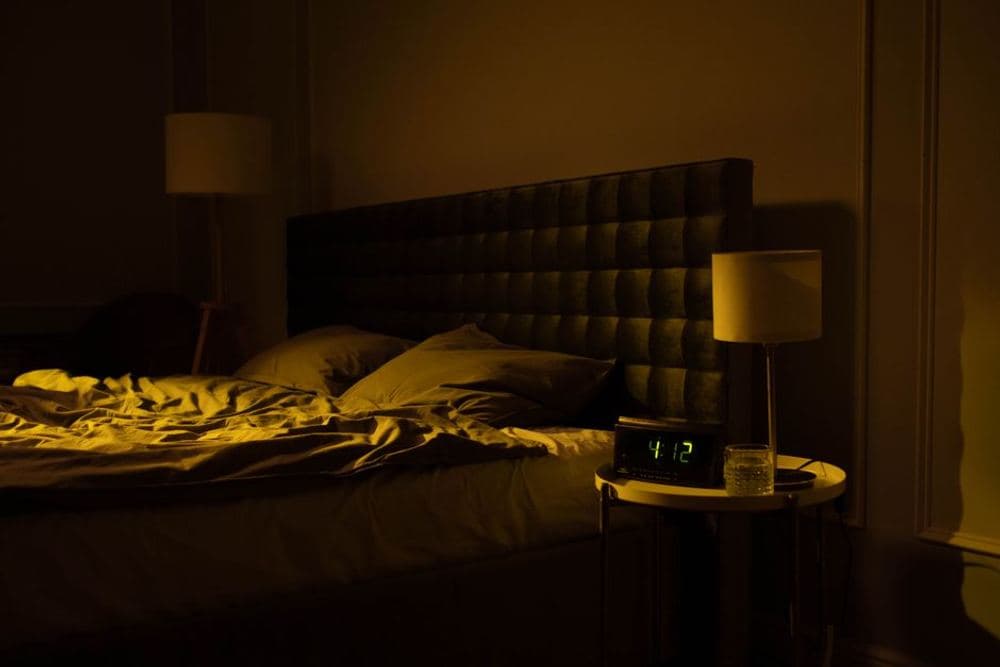
Insomnia is not one problem. Being unable to fall asleep because your mind will not settle is a different mechanism from waking at 3am and not getting back down, and a blanket is a plausible intervention for the first and a weak one for the second. When your brain will not shut off and falling asleep fine and waking at 3am separate those two, and exhausted all day, wide awake at midnight covers the third common pattern.
If the thing keeping you awake is noise or light, no blanket touches it - that is what sound machines and sleep masks are for. And if insomnia is persistent, the intervention with the strongest evidence base is cognitive behavioral therapy for insomnia, which is a clinical route rather than a purchase. The CDC’s sleep pages are a reasonable starting point for the general picture. We sell nothing that replaces a clinician.
The honest verdict
A weighted blanket is cheap relative to most sleep interventions, carries very little risk for a healthy adult who can lift it off, and has one decent trial behind it for exactly the problem you are searching about. That makes it a reasonable thing to try for two weeks. It also means the right expectation is “this might reduce how severe my insomnia feels” rather than “this will fix it”. If you want the version of this argument that is skeptical about the whole category, are weighted blankets worth it is the page, and do weighted blankets help anxiety covers the adjacent claim.
Three blankets if you want to try it
Tap any row to jump to the full write-up. Each thumbnail is the product photograph from that item’s own Amazon listing, and the price in the last column is the one Amazon showed at the last check.
| # | Product | Best for | The spec that decides it | Price |
|---|---|---|---|---|
| 1 | 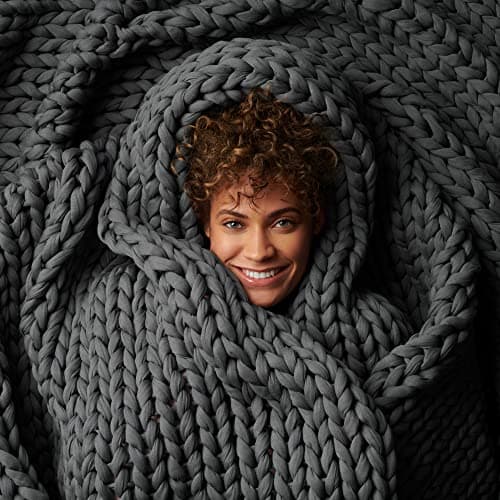 Bearaby Cotton NapperThe only mainstream weighted blanket with no beads at all - the weight is the yarn itself, so air moves straight through the knit. | Anyone who hates the sealed-duvet feeling | Bead-free: weight comes from organic cotton yarn | |
| 2 | 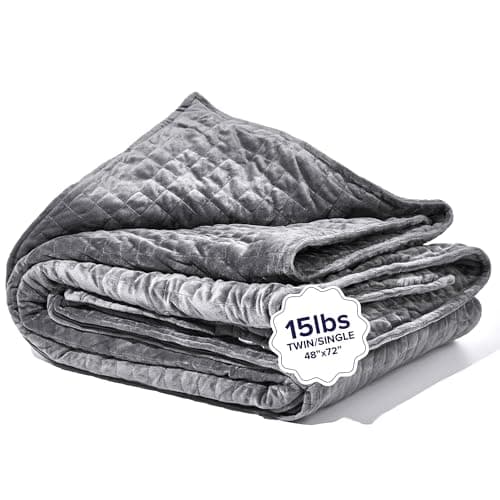 Gravity BlanketThe brand that made weighted blankets mainstream, and still the most even weight distribution of the bead blankets we shortlisted. | The evenly pinned, heavily tucked feeling | Evenly distributed glass beads with a removable cover | |
| 3 | 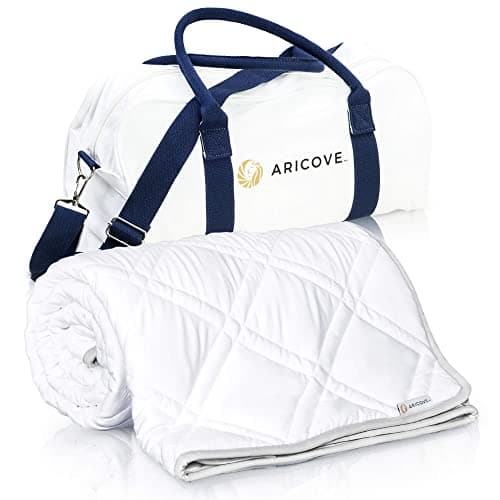 Aricove Cooling Weighted BlanketA cooling blanket that attacks heat at the surface: the face is twill-woven bamboo viscose, which feels cold to the touch and keeps feeling that way longer than cotton does. | Hot sleepers who still want real weight | Twill-woven bamboo viscose face, 15 lb at 48 x 72 in |
Prices come straight from Amazon and are refreshed daily; the date they were checked is stamped under the buy buttons below. If a price has gone stale or a listing has no offer, the button falls back to “Check price on Amazon” rather than showing a number we cannot stand behind. As an Amazon Associate we earn from qualifying purchases.
Chosen for the two things that decide whether someone with insomnia keeps using one: the quality of the pressure, and not overheating. Specifications are the manufacturers' own.
#ad How we are funded · price as of November 12, 2026
Our top pick · Anyone who hates the sealed-duvet feeling
1. Bearaby Cotton Napper
The only mainstream weighted blanket with no beads at all - the weight is the yarn itself, so air moves straight through the knit.
- Fill:
- None - weight is long-staple organic cotton yarn
- Weights:
- 10, 15, 20, 25 lb (manufacturer's published ladder)
- Construction:
- Open hand-knit weave
- Care:
- Machine washable
What it gets right
- No beads means no shifting, no bunching and no rustling
- The open knit breathes better than any quilted shell in this roundup
- Doubles as a sofa throw without looking like medical equipment
Where it falls short
- Among the most expensive options in the category
- The open weave catches on rings, watches and rough pet claws
- Heavy knit takes a long time to dry
Skip it if: You want the tucked-in, evenly pinned feeling a bead blanket gives. The knit drapes; it does not press.
#ad How we are funded · price as of November 12, 2026
Pick 2 · The evenly pinned, heavily tucked feeling
2. Gravity Blanket
The brand that made weighted blankets mainstream, and still the most even weight distribution of the bead blankets we shortlisted.
- Fill:
- Fine-grade glass beads on a precise stitched grid
- Cover:
- Premium micro-plush duvet cover, removable and machine washable
- Feel:
- Whole-body even pressure rather than localized weight
- Sizing:
- 15, 20 and 35 lb; the twin/single is 48 x 72 in
What it gets right
- The pressure is genuinely even end to end, which is the whole point of the category
- Removable cover means you wash the cover, not the 20 lb insert
- Widely stocked, so returns and exchanges are simple
Where it falls short
- Priced well above the equivalent YnM
- Duvet-style construction is warm
- Sized for one person, so it will not cover a shared bed
Skip it if: You want something you can throw over both of you on the sofa. This is a personal-sized blanket.
#ad How we are funded · price as of November 12, 2026
Pick 3 · Hot sleepers who still want real weight
3. Aricove Cooling Weighted Blanket
A cooling blanket that attacks heat at the surface: the face is twill-woven bamboo viscose, which feels cold to the touch and keeps feeling that way longer than cotton does.
- Fill:
- Superfine glass beads quilted between plush microfiber layers
- Fabric:
- Bamboo viscose twill, described by the maker as crisp and cooling
- Size:
- 48 x 72 in (twin/full), 15 lb - sized for one adult
- Care:
- Pre-washed, machine washable at 110F, wash on its own
What it gets right
- Bamboo viscose is the coolest-feeling face fabric in this roundup
- Beads are quilted between inner layers rather than loose in the shell, so nothing migrates
- Arrives pre-washed and plastic-free, ready to use the night it lands
Where it falls short
- Premium price for a 15 lb blanket
- Viscose needs a gentle wash - it is not a tumble-and-forget blanket
- One weight per size, so the ladder is narrower than the budget blankets
Skip it if: You share the blanket with a partner - 48 x 72 in is a one-person blanket, and the weight is distributed for one body.
Questions people actually ask
Do weighted blankets help with insomnia?
One randomized controlled trial found they can reduce insomnia severity: Ekholm and colleagues, published in 2020, compared a weighted chain blanket against a light control blanket over four weeks and found a significant benefit. The participants had insomnia alongside a diagnosed psychiatric condition, so the result does not automatically transfer to everyone, and it is a single trial rather than a body of evidence.
How long does it take for a weighted blanket to help with insomnia?
The trial behind the claim ran for four weeks. In practice most people know within two weeks whether a blanket suits them at all - the early complaints about restriction and heat usually fade in that window. Judge it at the end of a fortnight, not after three nights.
Is a weighted blanket a treatment for insomnia?
No. It is a low-risk thing to try that has some supporting evidence. The intervention with the strongest evidence base for persistent insomnia is cognitive behavioral therapy for insomnia, which is a clinical route rather than a purchase. Nobody on this site is qualified to advise on treatment.
What weight should I choose if I have insomnia?
The lighter of the two options you are considering. Too much weight reads as restriction, and restriction is the last thing you want when you are already lying awake paying attention to how your body feels. You can always move up later.
Why do I get too hot under a weighted blanket?
Because the fill adds thermal mass and the drape closes the air gaps a normal blanket leaves. That matters more for insomnia than for ordinary sleep, since core temperature has to fall for sleep onset. An open-knit or bamboo-viscose blanket, and a cooler room, are the two fixes that work.
Sources
- Ekholm B, Spulber S, Adler M. A randomized controlled study of weighted chain blankets for insomnia in psychiatric disorders. Journal of Clinical Sleep Medicine, 2020.
- American Academy of Sleep Medicine - Study shows weighted blankets can decrease insomnia severity (2020).
- Gringras P, Green D, Wright B, et al. Weighted blankets and sleep in autistic children - a randomized controlled trial. Pediatrics, 2014;134(2):298-306 (PubMed 25022743).
- Harding EC, Franks NP, Wisden W. Sleep and thermoregulation. Current Opinion in Physiology, 2020 (PMC7323637).
- CDC - About Sleep: recommended hours of sleep by age and sleep habits.
- Sleep Foundation - Best Weighted Blankets (specification comparison).
Back to the best weighted blankets.
Read next
- Are weighted blankets worth it?The skeptical read on the whole category.Read it
- Do weighted blankets help anxiety?The adjacent claim, examined the same way.Read it
 You fall asleep fine and wake up at 3amA different mechanism, and different gear.Read it
- How heavy should a weighted blanket be?Why lighter is usually the better bet.Read it