

How this page is funded: we earn a commission if you buy through the links below, at no extra cost to you. As an Amazon Associate we earn from qualifying purchases. It does not change which products we pick or the order they appear in. Full disclosure.
How these picks were made: by comparing published specifications and clearly-credited public reporting. We do not run a laboratory, we have not measured these products, and we do not claim to have slept with them. Here is exactly how we choose.
Short answer: buy the weighted blanket unless your problem is specifically that you want to feel held all over - including your arms and legs - in which case a compression product is the only one of the two that does it. The blanket gives you downward pressure you can get out from under, runs cooler, and costs less per pound of effect. The compression sheet or pod gives you whole-body inward squeeze, weighs almost nothing, and is far harder to escape mid-night.
These two products get compared because they are sold to the same person: someone who has worked out that pressure helps them settle and is now shopping for a way to buy it. But they deliver that pressure through completely different physics, and the physics is what should decide it.
Two different kinds of pressure
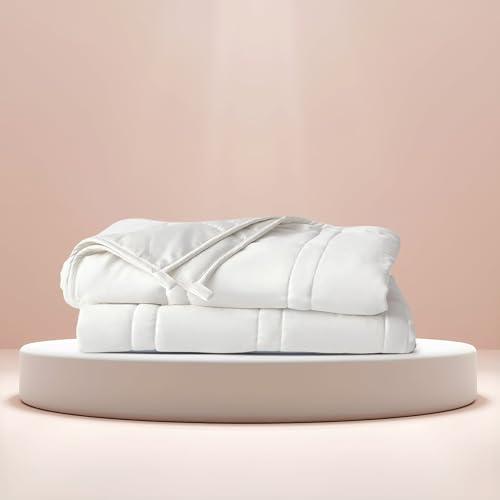
A weighted blanket is mass under gravity. Beads or dense yarn press down on whatever surface of you is facing up, and nothing presses on the sides of you at all. Roll onto your side and the blanket re-drapes; your arms are free; you can push it off in one movement.
A compression sheet - or a compression sleep pod, the tube-shaped version - is elastic tension. A stretch fabric is pulled taut around you and squeezes inward from every direction at once. There is no weight involved; the Sleep Pod’s own specifications describe a lightweight stretch garment sized to body height, not a heavy one.
That is not a small distinction. Downward pressure and circumferential pressure feel different, suit different people, and fail in different ways.
The comparison, spec by spec
| Weighted blanket | Compression sheet or pod | |
|---|---|---|
| Pressure direction | Downward only, from gravity | Inward from all sides, from elastic tension |
| Covers arms and legs | Legs yes, arms only if you keep them under | Yes - that is the whole point |
| Mobility | Roll freely; push it off in one movement | Restricted by design; getting out takes intent |
| Heat | Warm. Mass means fabric and fill | Cooler - a single thin stretch layer |
| Weight to carry or wash | 5-30 lb; a washer problem | Ounces; washes like a t-shirt |
| Sharing a bed | Poorly - weight pulls off your partner | Perfectly. It is personal, not shared |
| Travel | No | Yes - it packs to nothing |
| Fits over existing bedding | Yes, goes on top of whatever you have | No - it replaces or wraps around you |
Buy the weighted blanket if
- You want pressure you can leave. If you get up in the night, or you have any claustrophobic streak at all, downward weight is the forgiving option. You lift it and you are out.
- You change position a lot. A blanket re-drapes as you move. A compression garment holds the same shape whatever you do inside it.
- You want it to work on the sofa too. Half the value of a weighted blanket is that it is also a lovely object to be under at nine in the evening. A compression pod is bed equipment only.
- You want the better-evidenced option. The 2020 randomized trial behind weighted blankets, which the AASM covered, has no equivalent in the compression-sheet category that we could find. That is not proof compression does not work; it is a difference in what has been tested.
Buy the compression product if
- What you want is to feel held, not weighed down. Some people get nothing from a blanket on top and everything from being swaddled. If a tight sleeping bag is your happy place, this is your category.
- You sleep hot. One thin stretch layer beats any weighted construction on heat, full stop. If the hot-sleeper roundup still leaves you doubtful, compression sidesteps the problem instead of managing it.
- You share a bed. Nothing about a personal compression garment involves your partner. The weighted-blanket couples problem simply does not arise.
- You travel and want to take the effect with you. It packs into a carry-on. A 15 lb blanket does not.
When to skip both
If being constrained bothers you, both of these are the wrong purchase and the compression one is the worse of the two - it is specifically designed to restrict movement, and an elastic tube is much harder to exit at 3am than a blanket you can lift.
If the thing keeping you awake is heat, noise or light rather than restlessness, pressure is not the lever. Start from the problem instead - the gear that fixes a bright room or a snoring partner is in a different category entirely, and spending on pressure first is the most common way people end up with a drawer of sleep equipment and the same problem.
And if you are shopping for a child, neither is a casual purchase. Added weight and restricted movement both carry real safety rules - the kids page covers them, and the headline rule is that the child must be able to get out unaided.
The verdict
For most people reading this, the weighted blanket is the right first purchase: it is more versatile, easier to abandon if you hate it, better evidenced, and it does not commit you to a specific sleeping position. Buy a bead-free knit if you run warm, use the ten-percent weight rule, and size it to your body rather than your mattress with the size guide.
Reach for compression instead when the sensation you are chasing is being held all over - and when heat, a shared bed or a suitcase has already ruled the blanket out.
If the blanket is the right answer, start here
Tap any row to jump to the full write-up. Each thumbnail is the product photograph from that item’s own Amazon listing, and the price in the last column is the one Amazon showed at the last check.
| # | Product | Best for | The spec that decides it | Price |
|---|---|---|---|---|
| 1 | 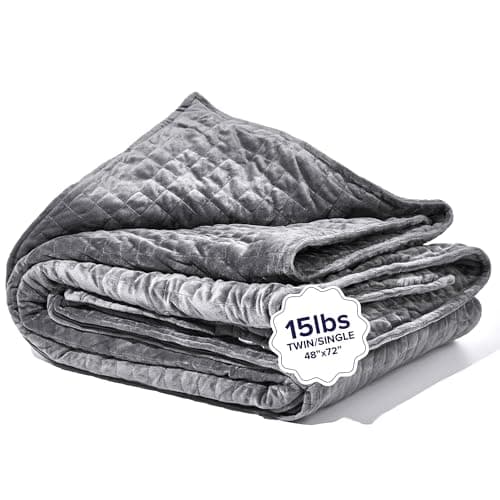 Gravity BlanketThe brand that made weighted blankets mainstream, and still the most even weight distribution of the bead blankets we shortlisted. | The evenly pinned, heavily tucked feeling | Evenly distributed glass beads with a removable cover | |
| 2 | 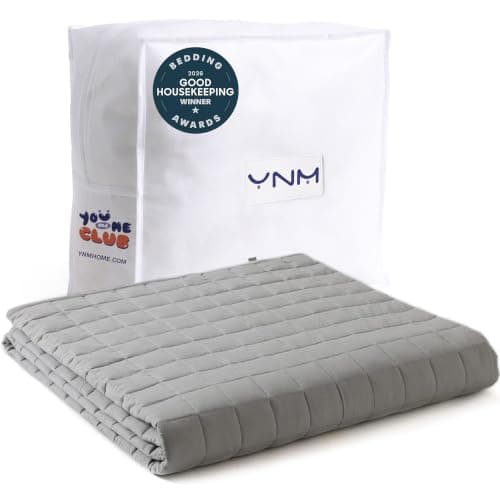 YnM Weighted BlanketThe sizing catalog, not the luxury pick: glass beads in small quilted pockets, in weights and dimensions from child up to king. | Odd sizes and weights nobody else makes | 2 x 2 in compartments - the smallest pockets in the category | |
| 3 | 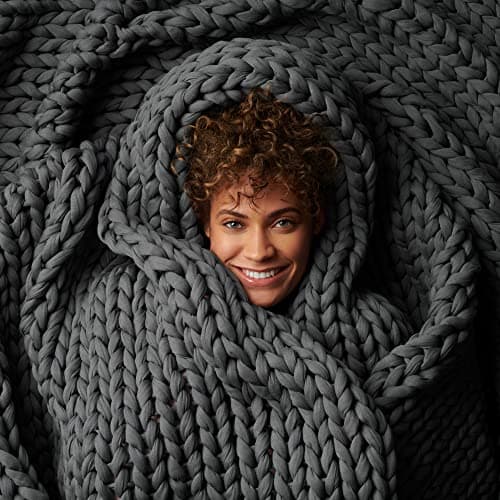 Bearaby Cotton NapperThe only mainstream weighted blanket with no beads at all - the weight is the yarn itself, so air moves straight through the knit. | Anyone who hates the sealed-duvet feeling | Bead-free: weight comes from organic cotton yarn |
Prices come straight from Amazon and are refreshed daily; the date they were checked is stamped under the buy buttons below. If a price has gone stale or a listing has no offer, the button falls back to “Check price on Amazon” rather than showing a number we cannot stand behind. As an Amazon Associate we earn from qualifying purchases.
Three blankets covering the three pressure feels - evenly pinned, firmly quilted, and draping. Every pick is a real, currently-sold product; none has been tested by us, and the specifications are the manufacturers' own.
#ad How we are funded · price as of November 23, 2026
Our top pick · The evenly pinned, heavily tucked feeling
1. Gravity Blanket
The brand that made weighted blankets mainstream, and still the most even weight distribution of the bead blankets we shortlisted.
- Fill:
- Fine-grade glass beads on a precise stitched grid
- Cover:
- Premium micro-plush duvet cover, removable and machine washable
- Feel:
- Whole-body even pressure rather than localized weight
- Sizing:
- 15, 20 and 35 lb; the twin/single is 48 x 72 in
What it gets right
- The pressure is genuinely even end to end, which is the whole point of the category
- Removable cover means you wash the cover, not the 20 lb insert
- Widely stocked, so returns and exchanges are simple
Where it falls short
- Priced well above the equivalent YnM
- Duvet-style construction is warm
- Sized for one person, so it will not cover a shared bed
Skip it if: You want something you can throw over both of you on the sofa. This is a personal-sized blanket.
#ad How we are funded · price as of November 23, 2026
Pick 2 · Odd sizes and weights nobody else makes
2. YnM Weighted Blanket
The sizing catalog, not the luxury pick: glass beads in small quilted pockets, in weights and dimensions from child up to king.
- Fill:
- Glass beads in 2 x 2 in compartments, the smallest YnM makes
- Construction:
- 7-layer system, with 16 loops for a duvet cover
- Sizing:
- Maker's rule: 10% of body weight plus 1 lb; 80 x 87 in or larger to share
- Care:
- Machine wash gentle, tumble dry low or line dry
What it gets right
- More weight-and-size combinations than anyone else, which matters if the ten percent rule lands you on an unusual number
- 2 x 2 in pockets keep beads distributed better than large-baffle designs
- Consistently the cheapest way into a proper glass-bead blanket
Where it falls short
- Shell fabric quality is the trade-off for the price
- Runs warm compared with cotton-knit options
- The duvet cover the 16 loops are for is sold separately
Skip it if: You are a hot sleeper. This is a warm blanket and no cover fixes that.
#ad How we are funded · price as of November 23, 2026
Pick 3 · Anyone who hates the sealed-duvet feeling
3. Bearaby Cotton Napper
The only mainstream weighted blanket with no beads at all - the weight is the yarn itself, so air moves straight through the knit.
- Fill:
- None - weight is long-staple organic cotton yarn
- Weights:
- 10, 15, 20, 25 lb (manufacturer's published ladder)
- Construction:
- Open hand-knit weave
- Care:
- Machine washable
What it gets right
- No beads means no shifting, no bunching and no rustling
- The open knit breathes better than any quilted shell in this roundup
- Doubles as a sofa throw without looking like medical equipment
Where it falls short
- Among the most expensive options in the category
- The open weave catches on rings, watches and rough pet claws
- Heavy knit takes a long time to dry
Skip it if: You want the tucked-in, evenly pinned feeling a bead blanket gives. The knit drapes; it does not press.
Questions people actually ask
What is the difference between a weighted blanket and a compression sheet?
A weighted blanket is mass under gravity: it presses down on whatever side of you faces up, and nothing touches your sides. A compression sheet or sleep pod is elastic tension: a stretch fabric squeezes inward from every direction at once and weighs only ounces. Downward pressure versus all-round squeeze is the whole distinction.
Which is better for sleeping hot, a weighted blanket or a compression sheet?
The compression product, clearly. It is one thin stretch layer, while any weighted blanket is fill plus shell plus cover - three insulating layers by construction. A bead-free Tencel knit is the coolest weighted option and still warmer than a compression garment.
Is a compression sheet safe to sleep in?
For an adult who can get out of it unaided, it is a restriction you have chosen. The real caution is claustrophobia and children: an elastic tube is much harder to exit mid-night than a blanket you can lift, and for a child the ability to get out unaided is a hard rule rather than a preference.
Do compression sheets have research behind them like weighted blankets?
Not that we could find. The weighted-blanket category has a 2020 randomized controlled trial showing reduced insomnia severity in a clinical group, covered by the American Academy of Sleep Medicine. We found no equivalent trial for compression sheets or pods, which is a difference in what has been tested rather than proof that they do not work.
Can you use a weighted blanket and a compression sheet together?
You can, and it is usually a bad idea. You get the heat of the blanket plus the restriction of the compression layer, and if the combination turns out to be too much you have two things to escape instead of one. Pick the sensation you actually want and buy that.
Sources
- Hug Sleep - Sleep Pod compression sleep garment (manufacturer specifications and sizing).
- Ekholm B, Spulber S, Adler M. A randomized controlled study of weighted chain blankets for insomnia in psychiatric disorders. Journal of Clinical Sleep Medicine, 2020.
- American Academy of Sleep Medicine - Study shows weighted blankets can decrease insomnia severity (2020).
- Harding EC, Franks NP, Wisden W. Sleep and thermoregulation. Current Opinion in Physiology, 2020 (PMC7323637).
- YnM - weighted blanket size guide (manufacturer sizes in inches, weight range, and the shared-bed weight table).
- Sleep Foundation - Best Weighted Blankets (specification comparison).
Back to the best weighted blankets.
Read next
- Best weighted blanketsThe full roundup if the blanket wins.Read it
 Are weighted blankets worth it?The prior question, answered honestly.Read it
- Weighted blanket vs comforterThe other comparison people mean when they ask this.Read it
 Best weighted blanket for couplesWhy one shared blanket rarely works.Read it
- Best weighted blanket for restless legsThe one case where tightly held legs is the wrong idea.Read it