
How this page is funded: we earn a commission if you buy through the links below, at no extra cost to you. As an Amazon Associate we earn from qualifying purchases. It does not change which products we pick or the order they appear in. Full disclosure.
How these picks were made: by comparing published specifications and clearly-credited public reporting. We do not run a laboratory, we have not measured these products, and we do not claim to have slept with them. Here is exactly how we choose.
Short version: the Hatch Restore 3 is the pick for most people reading this, because it is the one device that addresses both ends of the problem - a structured wind-down in the evening and a light-led wake in the morning - and because its controls are deliberately not a snooze bar you can slap. If you want sunrise quality with no app and no subscription, the Philips SmartSleep HF3520 is the better buy. If light alone has never woken you, add the Sonic Bomb bed shaker instead of buying a brighter lamp.
A quick note on what this page is and is not. We are a gear site; we do not treat ADHD and nothing here is medical advice. What we can do is read the research on why mornings are harder, and then be specific about which hardware features map onto it. If a clinician is involved in your sleep, their plan outranks any clock.
Why mornings are the hard part
The useful finding is not about willpower. A systematic review by Coogan and McGowan (2017) looked across the literature on circadian function and chronotype in ADHD and reported a consistent association with a later chronotype - a body clock that runs behind the schedule the world imposes. If your internal night ends at 2am and your alarm goes at 6:30, you are being woken mid-biological-night, every day.
That matters for what you buy, because it reframes the problem. The failure is not that the alarm is too quiet. It is that you are asking a device to end a night that is not finished. Two consequences follow:
- Light is the right lever, not volume. Light is the main input that shifts a body clock, which is the whole basis of the 2022 PLOS Biology light-exposure recommendations. Morning light earlier in the day pulls the clock earlier; a louder buzzer changes nothing about tomorrow.
- The evening matters as much as the morning. Bright light late pushes the clock later still. A device that dims the room and marks the end of the day is doing more work than the sunrise is.
The feature that actually decides it: how hard it is to dismiss
Every alarm clock can be turned off. The question is whether it can be turned off by a half-asleep hand without any part of you leaving the bed, because that is the loop that eats an hour.
This is where traditional clocks lose and it is also where a phone is at its worst - the dismiss action is the same swipe you perform three hundred times a day, and it requires no decision at all. Our sunrise alarm against your phone alarm page goes through that comparison properly, and how to stop hitting snooze is the behavior half of the fix.
| Clock | What it brings to an ADHD morning | Evening support |
|---|---|---|
| Hatch Restore 3 | Whole routine in one device; app-set, not a snooze bar | Yes - structured wind-down and dimming |
| Philips SmartSleep HF3520 | 20 light-intensity settings, no app or subscription to forget | Sunset dimming, no routine |
| Sonic Alert Sonic Bomb | Bed shaker - reaches you regardless of position or light | None |
| JALL Wake Up Light | Cheapest way to test whether light works on you at all | Sunset ramp |
| ecozy Sunrise | 30-minute ramp plus FM radio as a second trigger | Sunset dimming |
How we chose
- Resistance to a pillow-side dismiss. First criterion. A clock you configure in an app and then cannot casually reset is better than one with a big friendly snooze bar.
- Does it do the evening too? Given what the chronotype research suggests, a device that marks the end of the day is doing the structural work.
- Low setup burden. A clock that needs a weekly fight with an app is a clock that ends up unplugged. This counted against feature-heavy options, not for them.
- A second modality. Light plus sound, light plus radio, or vibration - because a single channel you have habituated to is a single point of failure.
- Price, honestly. If you do not know yet whether light wakes you, the correct purchase is the cheap one.
We have not tested these, we measure no lux values ourselves, and we publish no scores - the method is on how we choose what to recommend.
What a sunrise clock will not do
We would rather say this than sell you a lamp on a promise it cannot keep.
A sunrise clock will not make you a morning person. It will not fix sleep deprivation caused by going to bed at 2am; nothing on a nightstand can out-engineer four hours of sleep, which is the uncomfortable point of the tired-but-wired page. And it will not work on everybody - a meaningful share of people simply sleep through light, which is exactly why the heavy-sleeper roundup exists and why a bed shaker is on this list.
What it reliably does is three smaller things: it removes the startle of a buzzer, it puts a bright light in your eyes at a fixed time every day, and - if you pick one with an evening mode - it gives the end of the day a marker. Those are modest, real and cumulative.
Setting it up so it survives week three
The usual failure is not the hardware; it is that the routine dies. Three things make it stick.
Put it out of arm’s reach. Across the room, facing the bed. The light still reaches you and the controls do not. This single change does more than any upgrade.
Set the sunrise long, and the sound late. Twenty to thirty minutes of ramp with a sound trigger at the end gives light a chance to work before anything startles you. If the sound fires at minute one you have bought an expensive buzzer.
Charge the phone somewhere else. The clock cannot help if the phone is still the thing you reach for. This is the part people skip and it is the part that makes the rest work.
If you are buying for a teenager with a late body clock rather than for yourself, the same logic applies with different hardware - best alarm clocks for teens is that page, and sunrise alarms for kids covers younger children. Everything else in the category sits on the sunrise alarm hub.
Five clocks for a late body clock and a strong snooze habit
Tap any row to jump to the full write-up. Each thumbnail is the product photograph from that item’s own Amazon listing, and the price in the last column is the one Amazon showed at the last check.
| # | Product | Best for | The spec that decides it | Price |
|---|---|---|---|---|
| 1 | 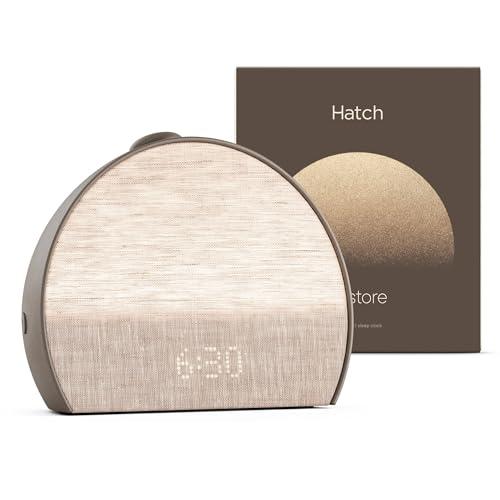 Hatch Restore 3The most complete bedside device of the group - sunrise, wind-down, sound library and alarms in one - and the only one with a subscription attached. | One device for the whole bedtime routine | Roughly 30-minute sunrise, deep orange through to bright white | |
| 2 | 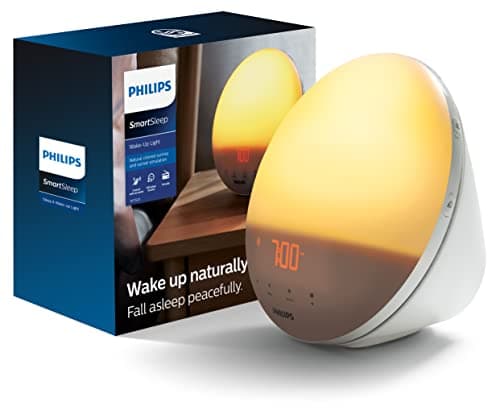 Philips SmartSleep Wake-Up Light HF3520The reference sunrise. No account, no app, no monthly fee - a dial, twenty brightness steps, and a light that ramps properly. | Sunrise quality with no app and no subscription | 20 light-intensity settings, no app or subscription | |
| 3 | 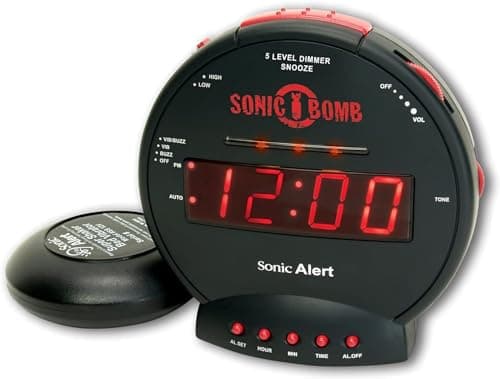 Sonic Alert Sonic Bomb (with Super Shaker)Not a sunrise clock at all - a vibrating pad that goes under the mattress, so waking you does not depend on which way your head is turned. | Side sleepers who face away from the light | 12-volt bed shaker; 113 dB alarm that can be switched off entirely | |
| 4 | 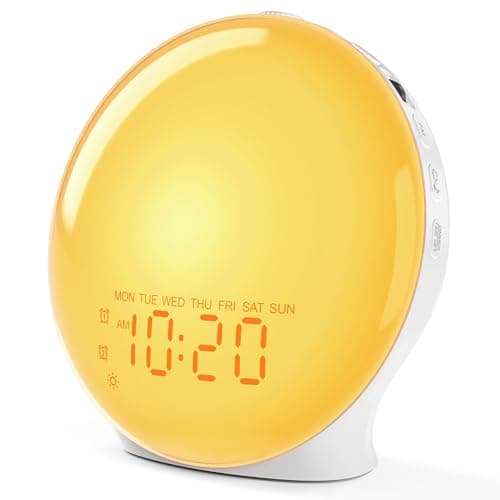 JALL Wake Up LightThe cheap way to test the idea. The light is dimmer than the premium units, but the mechanism is the same. | Finding out whether sunrise waking works for you | Full-screen display with colored sunrise, at entry-level pricing | |
| 5 | 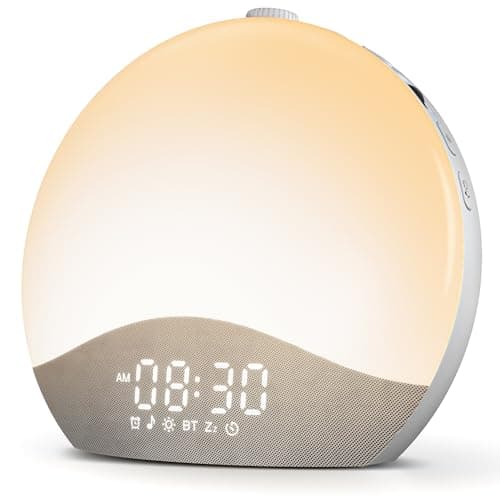 ecozy Sunrise Alarm ClockA sunrise light, a 26-sound masking machine and a Bluetooth speaker in one cheap box - the device to buy if you are testing the idea rather than committing to it. | The cheapest way to find out whether light wakes you | Sunrise wake light plus 26 sleep sounds and 17 night-light colors |
Prices come straight from Amazon and are refreshed daily; the date they were checked is stamped under the buy buttons below. If a price has gone stale or a listing has no offer, the button falls back to “Check price on Amazon” rather than showing a number we cannot stand behind. As an Amazon Associate we earn from qualifying purchases.
Ranked on how hard each one is to dismiss from under a duvet, and on whether it does anything for the evening as well as the morning. Every pick is a real, currently-sold product; none has been tested by us, and the specifications are the manufacturers' own.
#ad How we are funded · price as of November 12, 2026
Our top pick · One device for the whole bedtime routine
1. Hatch Restore 3
The most complete bedside device of the group - sunrise, wind-down, sound library and alarms in one - and the only one with a subscription attached.
- Sunrise:
- Gradual ramp beginning around 30 minutes before the alarm
- Color path:
- Deep orange warming to bright white
- Sound:
- Built-in sound library plus alarm tones
- App:
- Required for setup; premium library is subscription-gated
What it gets right
- Sunrise, wind-down and sound machine in a single footprint
- The app makes complex schedules genuinely easy to set
- The display dims properly, unlike most clock radios
Where it falls short
- The best sound content sits behind a subscription
- App dependency: no phone, no changes
- Most expensive way to buy a sunrise
Skip it if: You resent subscriptions. The Philips does the light half with no account at all.
#ad How we are funded · price as of November 12, 2026
Pick 2 · Sunrise quality with no app and no subscription
2. Philips SmartSleep Wake-Up Light HF3520
The reference sunrise. No account, no app, no monthly fee - a dial, twenty brightness steps, and a light that ramps properly.
- Light settings:
- 20 intensity levels
- Sunrise:
- Colored sunrise simulation before the alarm
- Sound:
- Natural wake-up sounds plus FM radio
- Account:
- None required
What it gets right
- Nothing to sign up for and nothing to update - it is an appliance
- Twenty brightness steps means you can actually find a comfortable display level
- Long-standing design with a well-understood service life
Where it falls short
- No app, so scheduling is manual
- The sound library is small and dated
- Larger footprint than the smart units
Skip it if: You want a sound machine and a sunrise in one device. This is a light first and foremost.
Pick 3 · Side sleepers who face away from the light
3. Sonic Alert Sonic Bomb (with Super Shaker)
Not a sunrise clock at all - a vibrating pad that goes under the mattress, so waking you does not depend on which way your head is turned.
- Wake method:
- 12-volt vibrating bed shaker, plus sound and flashing lights
- Alarm volume:
- 113 dB, with adjustable tone and volume
- Sound-free mode:
- Yes - the sound can be switched off to wake by vibration alone
- Snooze / duration:
- Snooze 1-30 minutes; alarm duration 1-59 minutes
- Other:
- Dual alarm, 5-level dimmer, battery backup for settings up to one week
What it gets right
- Vibration reaches you through the mattress regardless of sleeping position
- The loud alarm is optional, so one partner can be woken without the other
- Published, checkable specifications rather than vague marketing claims
Where it falls short
- No sunrise light at all - this solves waking, not the gentle part
- Styling and display are utilitarian at best
- 113 dB is genuinely startling, which is the opposite of a gradual wake
Skip it if: You want to be eased awake. This is a wake-up tool for people who sleep through everything, not a calm morning.
#ad How we are funded · price as of November 12, 2026
Pick 4 · Finding out whether sunrise waking works for you
4. JALL Wake Up Light
The cheap way to test the idea. The light is dimmer than the premium units, but the mechanism is the same.
- Sunrise:
- Configurable ramp before the alarm
- Colors:
- Multiple selectable light colors
- Sound:
- Built-in nature sounds plus FM radio
- Extras:
- Dual alarms, snooze, USB charging port
What it gets right
- A fraction of the price of the Philips or the Hatch
- Includes dual alarms and a USB port the premium units often omit
- Low risk if you are not sure the approach suits you
Where it falls short
- Peak brightness is well below the premium units, and that is the spec that matters most
- Build quality is what the price suggests
- Display dimming is coarser than the Philips
Skip it if: You are a genuinely heavy sleeper. Buy brightness - it is the one spec you cannot compromise on.
#ad How we are funded · price as of November 12, 2026
Pick 5 · The cheapest way to find out whether light wakes you
5. ecozy Sunrise Alarm Clock
A sunrise light, a 26-sound masking machine and a Bluetooth speaker in one cheap box - the device to buy if you are testing the idea rather than committing to it.
- Sunrise:
- Light ramps up to your set wake time rather than a sudden alarm
- Sounds:
- 26, from rain through to white noise
- Light:
- 17 colors, adjustable brightness, from night light to reading lamp
- Speaker:
- Dual speakers, pairs over Bluetooth
- Setup:
- Four steps: plug in, set the time, set the alarm, pick the light
What it gets right
- Cheap enough to treat as an experiment rather than a commitment
- The masking sounds mean it earns its nightstand space even on nights you do not use the alarm
- Doubles as a reading lamp and a colored bedside lamp
Where it falls short
- Peak brightness is well below a premium wake-up light
- Mains only, and the listing insists on the supplied adapter
- A 17-color light invites you to pick a blue, which is the wrong choice at bedtime
Skip it if: You are a genuinely heavy sleeper. Budget lights do not put out enough light to move a heavy sleeper on their own.
Questions people actually ask
Do sunrise alarm clocks work for ADHD?
They help with a specific part of the problem rather than all of it. A systematic review by Coogan and McGowan reported a consistent association between ADHD and a later chronotype, which means mornings are a body-clock mismatch rather than a willpower failure. Light is the main input that shifts a body clock, so a sunrise clock is the right category - but it cannot compensate for too little sleep.
What is the best sunrise alarm clock for ADHD?
The Hatch Restore 3, for most people, because it covers both ends of the day - a structured evening wind-down and a light-led wake - and it is configured in an app rather than dismissed with a snooze bar. If you do not want an app or a subscription, the Philips SmartSleep HF3520 is the better buy.
What if light does not wake me up at all?
That is common enough that we would plan for it. Add a second modality rather than a brighter lamp: the Sonic Alert Sonic Bomb uses a bed shaker under the mattress, so waking you does not depend on which way your head is turned or whether you are under a duvet.
Is a sunrise alarm better than a phone alarm for ADHD?
Usually, for one reason: dismissing a phone alarm is the same swipe you make hundreds of times a day and takes no decision at all. A separate device placed out of arm's reach breaks that loop. It also means the phone can charge in another room, which is the change that makes everything else work.
How long should the sunrise ramp be?
Long - twenty to thirty minutes - with any sound trigger set at the end rather than the start. That gives the light a chance to do something before anything startles you. A short ramp with an immediate sound is an expensive buzzer.
Will a sunrise clock make me a morning person?
No. It removes the startle of a buzzer, puts bright light in your eyes at a fixed time daily, and marks the end of the day if it has an evening mode. Those effects are real and cumulative but modest, and none of them substitutes for going to bed earlier.
Sources
- Coogan AN, McGowan NM. A systematic review of circadian function, chronotype and chronotherapy in attention deficit hyperactivity disorder. Attention Deficit and Hyperactivity Disorders, 2017 (PubMed 28064405).
- Brown TM et al. Recommendations for daytime, evening and nighttime indoor light exposure to best support physiology, sleep and wakefulness in healthy adults. PLOS Biology, 2022.
- Hatch - Restore 3 product page (manufacturer specifications and current subscription terms).
- Philips - SmartSleep Wake-up Light HF3520 product page (manufacturer specifications: colored sunrise simulation and 20 light-intensity settings).
- Sonic Alert Sonic Bomb alarm clock with Super Shaker - retailer listing of the manufacturer's published specifications (113 dB alarm, 12-volt bed shaker).
- Sleep Foundation - Best Sunrise Alarm Clocks.
- Tom's Guide - The best sunrise alarm clocks, tested and ranked.
Back to the best sunrise alarm clocks.
Read next
- Best sunrise alarm clocksThe main roundup across the whole category.Read it
- Sunrise alarm vs phone alarmWhy a separate device beats the thing in your hand.Read it
- How to stop hitting snoozeThe behavior half of the morning fix.Read it
- Best sunrise alarms for heavy sleepersWhat to buy if light alone has never worked.Read it
- Best alarm clocks for teensThe same late body clock, a different buyer.Read it