
How this page is funded: we earn a commission if you buy through the links below, at no extra cost to you. As an Amazon Associate we earn from qualifying purchases. It does not change which products we pick or the order they appear in. Full disclosure.
How these picks were made: by comparing published specifications and clearly-credited public reporting. We do not run a laboratory, we have not measured these products, and we do not claim to have slept with them. Here is exactly how we choose.
Short version: buy Mack’s Ultra Soft Foam first. It is rated NRR 33, the highest figure on the ordinary US retail shelf, and it costs about twenty cents a pair. If it hurts, the fix is almost never a different brand at the same rating - it is a narrower barrel or a lower-pressure foam, which is a different product and usually a slightly lower number. That trade is what this page is about.
We have not slept in any of these, we own no sound-level meter, and we assign no scores or star ratings to anything - the method is on how we choose what to recommend. What follows is the published specification for each plug, read against the specific problem each one is built to solve.
If you have not decided on foam yet, start one level up: foam versus silicone earplugs is the material decision, and the full earplug roundup covers reusable silicone and sleep earbuds as well. This page assumes you want foam and wants to tell you which foam.
The three specs that separate one foam plug from another
Foam earplugs look interchangeable and are not. Three things vary, and the order below is the order that decides most purchases.
1. Published NRR, which is the only number on the box
The Noise Reduction Rating is the US laboratory figure. On the retail shelf it runs from about 29 to 33 for foam, and that four-decibel spread is not trivial: decibels are logarithmic, so the top of the range blocks meaningfully more sound energy than the bottom. NRR 33 is the practical ceiling. Anything advertising a higher figure is almost always quoting SNR, the European standard, which reads several points higher for the same plug - the clearest example of that trap is on our Loop Quiet 2 review, where the same plug is published as 24 dB SNR abroad and 14 dB NRR in the US.
Both figures are also obtained with a textbook fit. NIOSH recommends derating published hearing-protector ratings for real-world use, because nobody seats a plug in bed the way a technician does in a test booth. Treat the number as a ceiling, not a promise.
2. Barrel diameter, which is not printed anywhere
This is the specification that decides whether you can tolerate the plug, and no packaging states it in millimeters. Standard foam plugs are sized for an average adult canal. Narrower ear canals are common - more common in women, and extremely common in anyone who has given up on foam entirely - and a standard barrel in a narrow canal does not just feel tight, it aches by about 2am as the foam keeps pushing outward against the canal wall.
Two of the five plugs here are built narrower on purpose: Mack’s Slim Fit and the Howard Leight Maximum Lite, which Honeywell lists as a smaller-diameter body for narrower canals. If regular foam has ever hurt you, go straight to one of those rather than trying a third standard-diameter plug.
3. Expansion pressure, which is the real reason people quit foam
Every foam plug is compressed, inserted, and then expands to seal. How hard it expands is a property of the foam formulation, and it varies a lot. Industrial hearing protection has a whole product class for this - Honeywell publishes the Maximum Lite as a “low pressure” polyurethane that expands gently to reduce that plugged, uncomfortable feeling over a long shift. An eight-hour night is a long shift.
Low pressure and maximum blocking are the two ends of one trade. A foam that presses harder seals more completely; a foam that expands gently is one you can still stand at 4am. Nobody sells you both.
A fourth consideration: cost per night, not cost per pack
Foam is disposable. A pair survives a few nights before it stops springing back, and a plug that has lost its rebound no longer seals, which means it no longer attenuates. The honest unit is cents per night. A 50-pair retail pack at around ten dollars is roughly twenty cents a pair; an industrial 200-pair box is often cheaper still per pair, which is why one of our picks is sold by the box even though the sticker price looks higher.
The five, compared
| Plug | Published NRR | Barrel | Buy it for |
|---|---|---|---|
| Mack’s Ultra Soft Foam | 33 dB | Standard | Maximum blocking at the lowest cost per night |
| Flents Protechs Quiet Time | 33 dB | Standard, cylindrical | The same ceiling in a different shape, when Mack’s will not seal |
| Mack’s Slim Fit | 31 dB | Narrow | Small or sensitive canals |
| Howard Leight Maximum Lite | 30 dB | Narrow, low pressure | Ears that ache in ordinary foam |
| Flents Protechs Super Sleep | 29 dB | Standard, soft | Staying wakeable for an alarm or a child |
Note what the table does not contain: a score, a star rating, or a “tested by us” column. Every rating above is the manufacturer’s own, and the ordering is ours - highest blocking first, then the reasons to come down the list.
The default: Mack’s Ultra Soft Foam, NRR 33
This is the plug almost everyone should buy first, and the reasoning is not subtle. Mack’s publishes it at NRR 33 dB, which is the top of what US retail sells, and a 50-pair pack costs about what a sandwich does. There is no cheaper way to make a bedroom quieter, and nothing else on this site competes on that ratio.
The honest cons. It is a standard-diameter barrel, so if your canals are narrow it will ache. It has to be rolled thin and inserted deep, which is more of the plug inside the ear you are lying on than a low-profile silicone plug puts there. And at NRR 33 you may genuinely sleep through an alarm you needed - that is not a theoretical risk, and it is the single most common reason to deliberately buy something lower-rated. The full treatment of that problem is on earplugs that still let you hear your alarm.
When Mack’s will not seal: Flents Quiet Time, NRR 33
People assume a plug that will not seal means they need a higher rating. Usually it means they need a different shape. Flents publishes the Quiet Time at NRR 33 - identical to Mack’s - in a cylindrical barrel rather than the tapered bullet most sleep foam uses. A cylinder fills a straight canal differently than a taper does, and for a minority of ears that is the whole difference between a seal and a whistle.
It is also sold in a 10-pair pack, which makes it the cheapest way to test whether barrel geometry is your problem. That matters, because the alternative is buying a full box of something that turns out to fit no better.
The honest cons. It costs more per pair than Mack’s for exactly the same published rating, so there is no reason to start here. A cylindrical barrel is less forgiving to insert than a tapered one - you have to roll it properly or it will not go in far enough to work. And it is disposable foam like everything else on this page, so the running cost never stops.
Narrow canals: Mack’s Slim Fit, NRR 31
A smaller-diameter version of the same ultra-soft foam, published at NRR 31 dB. Two decibels down from the flagship, and in exchange the barrel stops pressing on a canal that was never average-sized. If standard foam has always felt like it was being driven into your head, this is the first thing to try, not the last.
The honest cons. It is still foam: roll, insert deep, discard after a few nights. At NRR 31 the alarm problem has barely improved. And if your canals are not actually narrow, you have given up two decibels for nothing - the narrower barrel is a fix for a specific anatomy, not a general upgrade.
Ears that ache: Howard Leight Maximum Lite, NRR 30, low pressure
This is the industrial answer to a domestic problem, and it is the most interesting plug on the page. Honeywell builds the Maximum Lite around low-pressure polyurethane foam with a smooth, soil-resistant skin, in a contoured T-shape with a smaller-diameter body, published at NRR 30 under ANSI S3.19-1974. It exists because people wearing plugs for an eight-hour shift stop wearing them when the foam pushes too hard - which is the same reason people stop wearing them in bed.
It also happens to be the cheapest plug here per night. The LPF-1 box holds 200 pairs, which is roughly a year of nightly use, and works out to well under a quarter a pair.
The honest cons. It is sold in industrial quantities, so the up-front price looks high next to a 50-pair retail pack even though the cost per night is lower - and if the fit turns out to be wrong you own 199 spare pairs of the wrong plug. Three decibels below the NRR 33 options is a real gap, and you will hear it against a snorer. It is bright safety green, which some people genuinely mind on a nightstand.
Staying wakeable: Flents Super Sleep, NRR 29
The deliberately lower-rated pick, and the only one on this page sold specifically for sleeping rather than for work sites. Flents publishes it at NRR 29 and describes it on the listing as reducing pressure. Four decibels off the top is often exactly the margin between a phone alarm that gets through and one that does not.
Buy this one on purpose, not by accident. If you are a shift worker, a parent of a small child, or someone who needs to hear a smoke detector, a lower rating is a feature. If you have no such constraint, you are paying more for less blocking.
The honest cons. It is the most expensive per pair of the five. NRR 29 is not enough for loud snoring or a busy road - passive foam is weakest at low frequencies to begin with, and this has the least margin. And it is still disposable foam, with all the running cost and waste that implies.
The roll-down, which matters more than the pick
A plug rated NRR 29 that is seated properly beats a plug rated NRR 33 sitting loose in the outer ear. This is not a close call, and it is where most foam disappointment comes from. The technique:
- Roll, do not squeeze. Roll the plug between finger and thumb into a thin crease-free cylinder, about half its resting diameter. Squeezing it flat leaves folds, and folds leak.
- Pull the ear up and back with the opposite hand. This straightens the canal. Without it you are pushing foam into a bend, which is why it stops an inch short.
- Insert immediately and hold. Foam starts recovering the moment you let go of it. Hold it in place for 20 to 30 seconds while it expands against the canal wall.
- Check by talking. Your own voice should go muffled and boomy and your chewing should sound loud. If the room simply sounds slightly quieter, the plug is not in far enough.
- Replace them before they stop springing back. A plug that no longer recovers its shape in a few seconds no longer seals. That is usually two to four nights, sooner in a warm room.
The case foam does not solve: snoring
Snoring is the most common reason people come looking for earplugs and the problem passive foam handles worst. Snoring energy sits low in the spectrum, and passive attenuation of any material is weakest down there - research into improving low-frequency performance in passive plugs exists precisely because the standard designs give so little there. Johns Hopkins researchers have also measured snoring as genuine noise pollution, loud enough to matter at the sleeper beside it.
NRR 33 foam is still the best passive option, and it is where we would start. But if it is not enough, the next step is not a different foam plug - it is masking or active cancellation. Those routes are on best earplugs to block snoring and what to do when your partner snores and you cannot sleep.
Nightly use, honestly
Foam is the cheapest sleep intervention on this site and it is not free of downsides. The two worth knowing: anything sitting in the canal every night can interfere with the outward migration of earwax, and a reused plug carries whatever was on your hands when you rolled it. Replacing foam on schedule handles the second problem almost entirely. We have written the full version on whether it is bad to sleep with earplugs every night.
The other honest limit is hearing an alarm. At the top of the foam range you are removing roughly as much sound as a well-built wall, and that applies to the sounds you wanted too. Decide in advance which problem is worse for you, and buy the rating that matches.
The verdict
Buy Mack’s Ultra Soft Foam. It is NRR 33, it is pennies a night, and for most people the shopping ends there. If it hurts, do not buy another standard-diameter plug at the same rating - move to a narrow barrel (Mack’s Slim Fit) or a low-pressure foam (Howard Leight Maximum Lite) and accept two or three decibels less. If you must stay wakeable, buy the lower rating deliberately with Flents Super Sleep. And if no foam ever seals properly in your ears, the problem is the format rather than the brand - a headband or a white noise machine that masks instead of blocking is the better direction.
Five foam plugs, in the order we would try them
Tap any row to jump to the full write-up. Each thumbnail is the product photograph from that item’s own Amazon listing, and the price in the last column is the one Amazon showed at the last check.
| # | Product | Best for | The spec that decides it | Price |
|---|---|---|---|---|
| 1 | 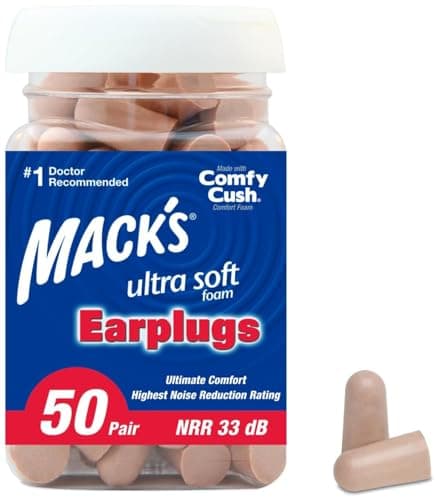 Mack's Ultra Soft Foam EarplugsThe highest-rated foam plug in common retail, at a price where losing one in the sheets does not matter. | Maximum blocking for the least money | NRR 33 dB - the highest rating in this roundup | |
| 2 | 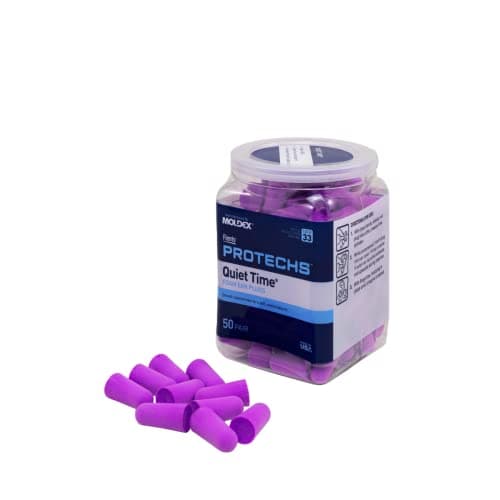 Flents Protechs Quiet Time Foam Ear PlugsThe same NRR 33 ceiling as the category leader in a different barrel shape, which is the only thing that matters once a plug has refused to seal in your ear. | Top-rated blocking when the Mack's barrel will not seal | NRR 33 dB, cylindrical barrel, 50 pairs | |
| 3 | 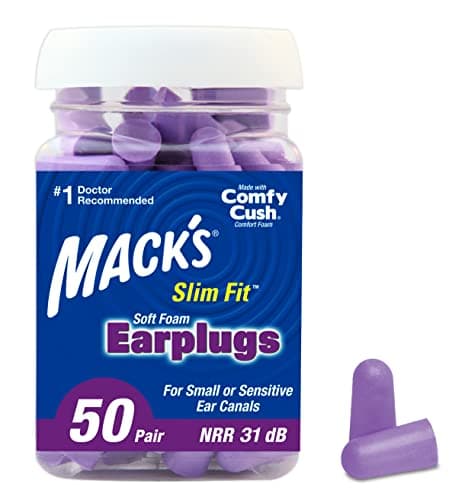 Mack's Slim Fit Soft Foam EarplugsA smaller-diameter version of the standard soft foam plug, which is exactly why it works for people whose ears ache in regular foam by 2am. | Small or sensitive ear canals that standard foam hurts | NRR 31 dB in a narrower barrel | |
| 4 | 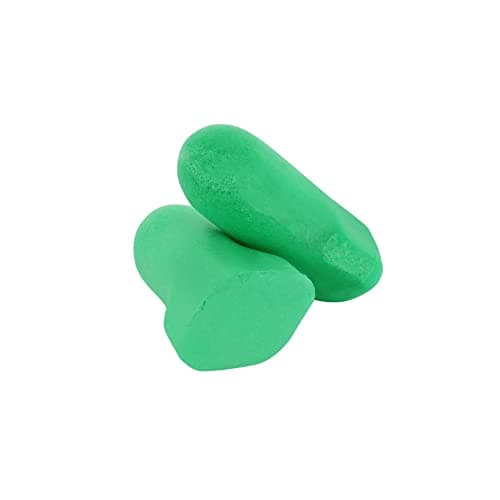 Howard Leight Maximum Lite (LPF-1)An industrial plug built around low expansion pressure instead of maximum blocking - the closest thing on the shelf to foam that does not push back. | Ears that ache in ordinary foam by 2am | NRR 30 dB in low-pressure foam, smaller barrel | |
| 5 | 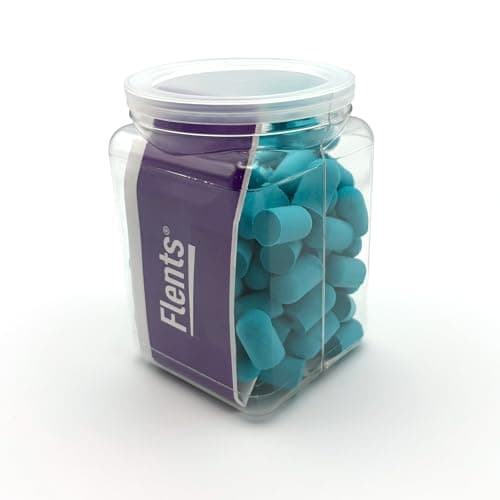 Flents Protechs Super Sleep Foam Ear PlugsA sleep-specific foam plug that trades four decibels for a softer, lower-pressure body - and leaves you enough hearing to catch an alarm or a child. | Anyone who has to stay wakeable | NRR 29 dB, pressure-reducing sleep foam |
Prices come straight from Amazon and are refreshed daily; the date they were checked is stamped under the buy buttons below. If a price has gone stale or a listing has no offer, the button falls back to “Check price on Amazon” rather than showing a number we cannot stand behind. As an Amazon Associate we earn from qualifying purchases.
Start at the top rating and work down the list only if comfort forces you to. Every figure below is the manufacturer's own published rating - we own no acoustic test equipment and have not measured any of these.
#ad How we are funded · price as of November 12, 2026
Our top pick · Maximum blocking for the least money
1. Mack's Ultra Soft Foam Earplugs
The highest-rated foam plug in common retail, at a price where losing one in the sheets does not matter.
- Rating:
- NRR 33 dB (manufacturer figure)
- Material:
- Slow-recovery polyurethane foam
- Reuse:
- A few nights each, then discard
- Sold as:
- Bulk packs
What it gets right
- Nothing in common retail blocks more
- Cheap enough to replace constantly, which is also more hygienic
- The soft compound is tolerable for side sleepers once compressed correctly
Where it falls short
- Only works if you roll and insert them properly - most complaints are fit, not product
- Disposable, so there is an ongoing cost and ongoing waste
- At 33 dB you will very likely sleep through a standard alarm
Skip it if: You have to hear an alarm, a child, or a smoke detector. This is the wrong tool for that night.
#ad How we are funded · price as of November 12, 2026
Pick 2 · Top-rated blocking when the Mack's barrel will not seal
2. Flents Protechs Quiet Time Foam Ear Plugs
The same NRR 33 ceiling as the category leader in a different barrel shape, which is the only thing that matters once a plug has refused to seal in your ear.
- Rating:
- NRR 33 dB (figure printed on the listing by Flents)
- Material:
- Soft polyurethane foam
- Shape:
- Cylindrical barrel rather than the tapered bullet most sleep foam uses
- Pack:
- 50 pairs; also sold in a 10-pair pack to test the fit
What it gets right
- Matches the highest NRR on the US retail shelf
- A genuinely different barrel geometry, so it is worth trying when a tapered plug has failed you
- The 10-pair pack means a fit test costs a few dollars rather than a full box
Where it falls short
- Costs more per pair than Mack's Ultra Soft for the same published rating
- A cylindrical barrel is less forgiving to insert than a tapered one
- Disposable, so the running cost never stops
Skip it if: Standard tapered foam already seals comfortably for you. There is nothing here you are not already getting more cheaply.
#ad How we are funded · price as of November 12, 2026
Pick 3 · Small or sensitive ear canals that standard foam hurts
3. Mack's Slim Fit Soft Foam Earplugs
A smaller-diameter version of the standard soft foam plug, which is exactly why it works for people whose ears ache in regular foam by 2am.
- Rating:
- NRR 31 dB (manufacturer figure)
- Material:
- Ultra-soft polyurethane foam with a smooth skin
- Fit:
- Smaller diameter than standard foam plugs
- Reuse:
- A few nights each, then discard
What it gets right
- The most blocking on this page, by a clear margin
- The narrower barrel is the specific fix for canals that standard foam presses on
- Cheap enough per pair that losing one in the sheets is a non-event
Where it falls short
- Foam still has to be rolled and inserted deep, and a deep plug puts more of itself inside the ear you are lying on
- At 31 dB you may sleep through an alarm you need to hear
- Disposable, so there is a permanent running cost and ongoing waste
Skip it if: You have to hear an alarm, a child or a smoke detector. Nothing about a high NRR is a feature on that night.
#ad How we are funded · price as of November 12, 2026
Pick 4 · Ears that ache in ordinary foam by 2am
4. Howard Leight Maximum Lite (LPF-1)
An industrial plug built around low expansion pressure instead of maximum blocking - the closest thing on the shelf to foam that does not push back.
- Rating:
- NRR 30 dB (Honeywell's published figure, ANSI S3.19-1974)
- Material:
- Low-pressure polyurethane foam with a smooth, soil-resistant skin
- Shape:
- Contoured T-shape, smaller-diameter body for narrower canals
- Pack:
- 200 pairs (LPF-1 box) - roughly a year of nightly use
What it gets right
- Expands gently, which is the single specification that decides whether you still have them in at 4am
- The smaller barrel suits narrow canals without dropping to a low rating
- Bought by the box, the cost per night is the lowest of anything here
Where it falls short
- Sold only in industrial box sizes, so the up-front price looks high next to a 50-pair retail pack
- Three decibels below the NRR 33 plugs, and you feel that against a snorer
- Bright safety green, which some people dislike on a nightstand
Skip it if: You want maximum attenuation. Low pressure and maximum blocking are the two ends of the same trade, and this plug is at the comfort end.
#ad How we are funded · price as of November 12, 2026
Pick 5 · Anyone who has to stay wakeable
5. Flents Protechs Super Sleep Foam Ear Plugs
A sleep-specific foam plug that trades four decibels for a softer, lower-pressure body - and leaves you enough hearing to catch an alarm or a child.
- Rating:
- NRR 29 dB (figure printed on the listing by Flents)
- Material:
- Soft foam; the listing describes it as reducing pressure
- Intended use:
- Sold specifically for sleeping rather than for work sites
- Pack:
- 50 pairs; also sold in a 10-pair pack
What it gets right
- The lowest-pressure retail foam plug that still reaches the high twenties
- Four decibels down from the top is usually the difference between hearing an alarm and not
- Sold in a small pack, so trying it is cheap
Where it falls short
- The most expensive per pair of any plug on this page
- NRR 29 is not enough for loud snoring or a busy road
- Disposable, like all foam
Skip it if: Your problem is a snorer. Start at NRR 33 and work down only if comfort forces you to.
Questions people actually ask
What is the highest NRR foam earplug you can buy?
NRR 33 dB is the practical ceiling on the US retail shelf, and several plugs reach it - Mack's Ultra Soft Foam and Flents Protechs Quiet Time both publish 33. If you see a higher number advertised, check whether it is actually SNR, the European rating, which reads several points higher for the same plug and cannot be compared with NRR directly.
Are foam earplugs better than silicone for sleeping?
For blocking, yes, and by a wide margin: retail foam reaches NRR 33 while most reusable silicone sleeping plugs sit in the teens. For comfort against a pillow, silicone usually wins, because foam has to be inserted deep and keeps pushing outward. Pick foam if your problem is noise volume, silicone if your problem is that plugs hurt.
Which foam earplugs are best for small ears?
A plug built on a narrower barrel rather than a different brand at the same diameter. Mack's Slim Fit is published at NRR 31 in a smaller-diameter body, and Honeywell lists the Howard Leight Maximum Lite as a smaller-diameter plug at NRR 30. Both give up a little attenuation and stop the ache that standard foam causes in a narrow canal.
How many nights can you use the same foam earplugs?
Two to four nights is a realistic working life, and the test is mechanical rather than calendar-based: squeeze the plug and let go. If it does not spring back to its original shape within a few seconds, the foam is spent and it will no longer seal, which means it is no longer blocking anything. Warm rooms and oily skin shorten that life.
Why do my foam earplugs hurt after a few hours?
Almost always expansion pressure against a canal that is narrower than the plug was designed for. Foam keeps pushing outward for as long as it is in, so a slightly oversized plug that felt fine at midnight is painful by 2am. The fix is a narrower barrel or a foam formulated for low expansion pressure, not a softer plug at the same diameter.
Will foam earplugs block out my partner's snoring?
Partly. NRR 33 foam is the best passive option you can buy and it will take the peaks off, but snoring is low-frequency noise and passive plugs of every material are weakest at low frequencies. If the snoring is loud and sustained, plan on masking or active cancellation as well rather than hunting for a higher-rated plug.
Are industrial foam earplugs safe to sleep in?
They are the same product as the sleep-marketed ones - polyurethane foam, the same ANSI test standard, often the same factories. The practical differences are pack size, color and barrel shape, not safety. An industrial box is usually the cheapest way to buy the exact plug you have already decided fits.
Sources
- Mack's - Ear Plugs for Sleeping (manufacturer specifications).
- Mack's - Slim Fit Soft Foam Ear Plugs (manufacturer specifications: NRR 31 dB, polyurethane foam, smaller diameter for small or sensitive ear canals).
- Flents - Protechs Quiet Time foam ear plugs, NRR 33, 50 pair (Amazon listing, specifications as published by the seller).
- Flents - Protechs Super Sleep foam ear plugs, NRR 29, 50 pair (Amazon listing, specifications as published by the seller).
- Howard Leight by Honeywell Maximum Lite LPF-1 - distributor listing of the manufacturer's published specifications (NRR 30, low-pressure polyurethane foam with a smooth soil-resistant skin, contoured T-shape, smaller-diameter body, ANSI S3.19-1974).
- NIOSH - Criteria for a Recommended Standard: Occupational Noise Exposure (DHHS/NIOSH 98-126), hearing protector NRR derating recommendation.
- Carillo K, Sgard F, Dazel O, Doutres O. Improving low-frequency attenuation of passive earplugs using Helmholtz resonators. Journal of the Acoustical Society of America (IRSST record).
- Sowho M, Sgambati F, Guzman M, Schneider H, Schwartz A. Snoring: a source of noise pollution and sleep apnea predictor. Sleep, 2020;43(6):zsz305 (Johns Hopkins School of Medicine).
- NIDCD (National Institute on Deafness and Other Communication Disorders, NIH) - Noise-Induced Hearing Loss.
Back to the best white noise machines.
Read next
- Best earplugs for sleepingThe whole category: foam, silicone and earbuds together.Read it
- Foam vs silicone earplugsThe material decision this page assumes you have already made.Read it
 Best earplugs for sleeping that don't hurtIf every foam plug has failed you, start here instead.Read it
 Earplugs that still let you hear your alarmWhy buying a lower rating is sometimes the right call.Read it
- Loop Quiet 2 reviewThe reusable silicone alternative, and the NRR-versus-SNR trap.Read it