

How this page is funded: we earn a commission if you buy through the links below, at no extra cost to you. As an Amazon Associate we earn from qualifying purchases. It does not change which products we pick or the order they appear in. Full disclosure.
How these picks were made: by comparing published specifications and clearly-credited public reporting. We do not run a laboratory, we have not measured these products, and we do not claim to have slept with them. Here is exactly how we choose.
Short version: buy the Nidra if you want contoured blackout and you sleep on your side. It is the mask that solves the contoured category’s central problem - cups that hold the fabric off your eyes also hold the mask off your face, and a pillow drives that rim into your cheekbone. Nidra’s side panels are deliberately thin, which is the whole reason it works on a pillow. It is the wrong mask if your light leak is at a high nose bridge, because the fit is not adjustable and no strap tension fixes a gap there.
A note on what this is. We have not slept in this mask, we own no light meter, and we assign no scores or star ratings to anything - the method is on how we choose what to recommend. What follows is a close read of what Nidra publishes, set against the rest of the category and against the problem you are probably trying to solve. You will also see this mask listed by some retailers as the Deep Rest; the current listing calls it the Contoured Sleep Mask and it is the same contoured design.
What a contoured mask is actually for
A flat mask - silk, cotton, foam panel - rests on your eyelids. That is fine for most people and it is why the cheap ones sell so well. It becomes a problem in three specific cases: you wear eye makeup or lash extensions, you dislike pressure on the eyeball, or your eyes move under the fabric enough that the contact itself wakes you.
A contoured mask puts a molded cavity in front of each eye and bears on your brow bone, cheekbone and nose instead. Nidra publishes it as deep cups with zero pressure on the eyes and 100 percent light blocking. The cavity is the product; the fabric is secondary. We treat the whole family on sleep masks that don’t touch your eyes.
And blackout is worth getting right rather than approximately right. Light at night is one of the better-evidenced sleep variables there is - published recommendations for nighttime indoor light exposure put the bedroom target very low indeed, lower than most people’s rooms manage. A mask that leaks is a mask that is not doing the one job you bought it for.
The specification that decides it, and it is not cup depth
Every review of this category talks about how deep the cups are. Depth is the wrong number to optimize. What decides whether you can live with a contoured mask is how far the side panels stand off your face, because that is the part a pillow pushes on.
The Manta Pro is the clearest illustration. It is the better mask on blackout - modular cups you can move, deeper cavities, a more complete seal - and it is genuinely too much mask for a strict side sleeper, because the same depth that clears your lashes also creates a rim that your pillow drives into your cheekbone. Nidra’s answer is a molded cup with slim side panels: you lose a little light-blocking margin at the temples and gain a mask you can lie on. That is the entire trade, and for most side sleepers it is the right side of it. The broader shortlist is on best sleep masks for side sleepers.
If you sleep on your back, note that this trade does not benefit you at all. A back sleeper has nothing pressing on the side panels and should simply buy the mask that blocks the most light.
Where it leaks, honestly
“One hundred percent light blocking” is a manufacturer claim about a mask in isolation, not about a mask on your face. On a contoured mask, light gets in at one place almost every time: the nose bridge. The cups seal against bone; the gap between them has to seal against cartilage and skin, and faces vary more there than anywhere else on the mask’s contact line.
The practical test is the one we recommend for any mask: put it on in a lit room, close your eyes, then look down toward your feet without moving your head. If you see a wedge of light at the bottom of your vision, that is the nose gap. On a non-adjustable mask like this one, your options are to live with it, add a rolled-up section of a soft cloth under the bridge, or buy a mask with movable cups. That last route means the Manta Pro, which exists specifically because this problem is unsolvable with a fixed shape - our Manta Pro review covers what the modularity buys.
For genuine daytime blackout - night shift, a bedroom you cannot darken - we would not rely on any single mask alone. The combination approach is on best blackout sleep masks and how to make a bedroom dark for sleeping.
Fit, strap and the thing that is not adjustable
The Nidra uses a single adjustable strap in a standard size. That is simple and it works, and it is also the clearest difference from the premium shelf. On a Manta, the cups themselves slide; on a Nidra, the cups are where they are and the strap is the only variable. If your eyes sit unusually wide or narrow relative to the molded cavities, there is nothing to do about it.
- Tighten less than you think. A contoured mask seals by sitting squarely on bone, not by being clamped on. Over-tightening pushes the rim into your brow and gives you the headache people blame on the mask itself.
- Strap position matters on a pillow. Get the adjuster around to the back or side of your head rather than letting it sit where your ear meets the pillow.
- Give it three nights. Nearly everyone finds a contoured mask strange on night one. The ones who abandon them usually do so before their face has adapted to bearing weight on the brow and cheek.
Against the two masks it is usually compared with
| Mask | Shape | What you are buying |
|---|---|---|
| Nidra Contoured | Molded cups, thin side panels | Contoured blackout you can lie on, at a budget price |
| Manta Sleep Mask Pro | Modular cups, deep | Adjustable cup position: the only real fix for a nose-bridge leak |
| MZOO | Molded, curved thin sides | The other budget contoured option, sold for side sleeping too |
Against the Manta, the question is whether you need adjustability. If a fixed shape seals on your face, the Nidra gives you most of the benefit for a fraction of the money and is easier to sleep on. If a fixed shape leaks on your face, no amount of saving makes it the right purchase. Reviewers who test the category at length - TechGearLab and CNN Underscored among them - consistently put the modular masks at the top on blackout and the molded budget masks at the top on value, which matches how we rank them.
Against MZOO, honestly, it is close. Both are molded masks with slim sides sold for side sleeping, in the same price band. We put the Nidra first on the blackout-to-bulk ratio, but if one is unavailable the other is not a downgrade. The cheaper alternatives to a Manta are collected on Manta Sleep Mask dupes.
Durability, which is the real cost
This is where the price lands. The molded foam and the fabric covering it wear faster than the premium masks’ materials do, and the strap is the first thing to loosen. Expect to replace a budget contoured mask rather than keep it for years.
That is not necessarily a bad deal. A mask you replace every year or two at this price is still cheaper than one premium mask, and a mask that has gone slack is a mask that leaks - so a product you are willing to replace is arguably safer for the job than one you feel obliged to keep. Just build it into the comparison rather than treating the sticker price as the lifetime cost.
One care note that extends it: do not machine wash a molded mask. Spot clean the contact surfaces and let it dry fully in open air. Water through foam and a hot dryer are what collapse the cups.
Who should not buy this mask
- Anyone with a high or narrow nose bridge. The fixed cup spacing is the limitation, and the fix costs more. Buy adjustable cups.
- Strict back sleepers who want maximum blackout. You are paying a blackout penalty for side-sleeping comfort you do not need.
- Anyone who wants to feel almost nothing. A contoured mask is a structure on your face. If what you actually want is the lightest possible thing, a flat silk mask is the honest answer - we cover when that is the right call on are sleep masks worth it.
- Anyone needing audio in the same object. Different product category entirely; start at best sleep masks with headphones.
The verdict
The Nidra is the mask we keep recommending inside roundups, and it earns that for one reason: it is the cheapest way to get a molded, no-pressure cavity in front of your eyes in a shape you can actually sleep on. It blocks less light than a Manta Pro, it will not last as long, and its fit is take-it-or-leave-it. For a side sleeper who wears makeup or lashes, or simply hates fabric on the eyeball, none of those are the deciding factor.
Start here. If it leaks at the bridge on your face, that is the signal to spend the extra money on adjustable cups rather than to try a third fixed-shape mask - and the whole category, ranked by the fit problem it solves, is on the best sleep masks.
The Nidra, and the two masks it is usually weighed against
Tap any row to jump to the full write-up. Each thumbnail is the product photograph from that item’s own Amazon listing, and the price in the last column is the one Amazon showed at the last check.
| # | Product | Best for | The spec that decides it | Price |
|---|---|---|---|---|
| 1 | 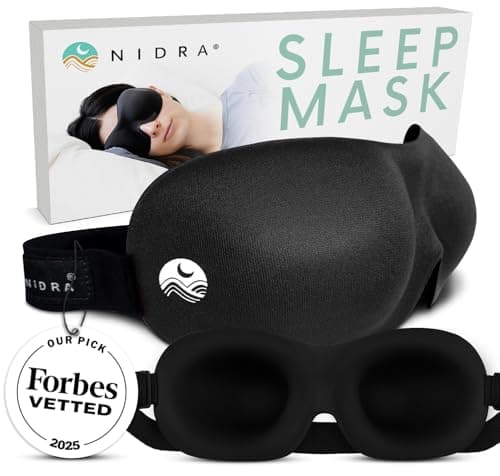 Nidra Contoured Sleep MaskMolded eye cups with slim side panels - it keeps the no-pressure benefit of a contoured mask without the depth that ruins side sleeping. | Side sleepers who still want contoured blackout | Deep 3D cups with deliberately thin side panels | |
| 2 | 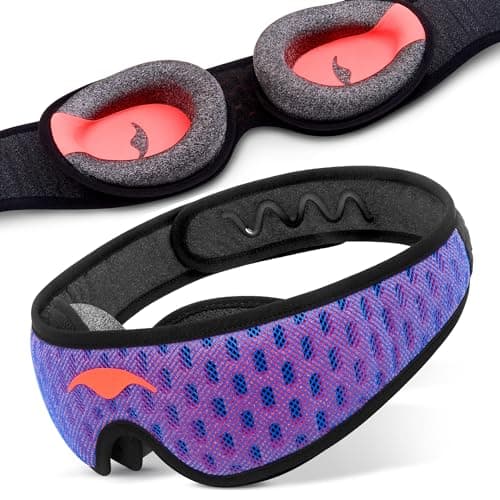 Manta Pro Sleep MaskThe most adjustable mask in the category: the eye cups move independently, so you can seal a nose bridge that defeats every one-piece mask. | Total blackout with room for long lashes | Independently repositionable eye cups, zero eye pressure | |
| 3 | 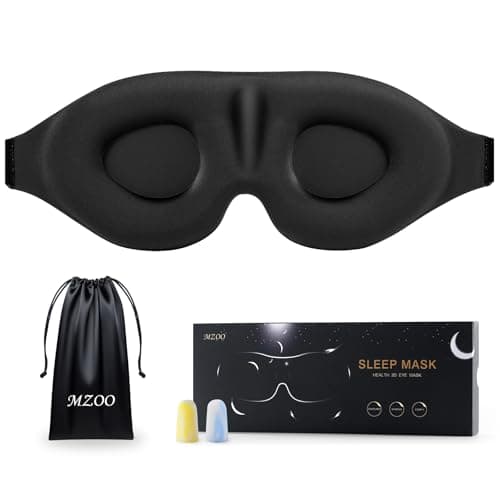 MZOO Luxury Sleep MaskA contoured memory-foam mask at commodity pricing: the deepest eye cups of the cheap masks, and thin curved sides so it still works on a pillow. | Blackout on a budget | 13 mm arc-shaped eye cups with 22 mm nose padding |
Prices come straight from Amazon and are refreshed daily; the date they were checked is stamped under the buy buttons below. If a price has gone stale or a listing has no offer, the button falls back to “Check price on Amazon” rather than showing a number we cannot stand behind. As an Amazon Associate we earn from qualifying purchases.
The review subject first, then the premium modular mask that blocks more and costs several times as much, then the other budget contoured option. Specifications are the makers' own; we have not slept in any of these.
#ad How we are funded · price as of November 12, 2026
Our top pick · Side sleepers who still want contoured blackout
1. Nidra Contoured Sleep Mask
Molded eye cups with slim side panels - it keeps the no-pressure benefit of a contoured mask without the depth that ruins side sleeping.
- Construction:
- Deep contoured 3D cups over low-rebound memory foam
- Side panels:
- Thin, which is what the maker rates for side sleeping
- Eye pressure:
- None - spacious cups clear lashes and extensions
- Strap:
- Adjustable; standard size
What it gets right
- The best blackout-to-bulk ratio in this roundup
- Cheap relative to the premium contoured masks
- Lash clearance is real, which matters if you wear eye makeup or lash extensions
Where it falls short
- Less adjustable than a modular mask - the fit is the fit
- Nose-bridge sealing depends on your face shape
- Fabric wears faster than the premium options
Skip it if: Your light leak is at a high nose bridge. Buy adjustable cups instead.
#ad How we are funded · price as of November 12, 2026
Pick 2 · Total blackout with room for long lashes
2. Manta Pro Sleep Mask
The most adjustable mask in the category: the eye cups move independently, so you can seal a nose bridge that defeats every one-piece mask.
- Construction:
- Modular cups on a hook-and-loop band
- Eye pressure:
- None - the cups arch over the eye socket
- Adjustment:
- Cups reposition horizontally to match your face
- Strap:
- Wide adjustable band; the maker rates it for side sleeping
What it gets right
- Seals light at the nose bridge better than any fixed-shape mask once fitted
- No contact with the eyelid, so you can blink freely and sleep in contacts
- Spacious cups are the reason this is the lash-extension pick
Where it falls short
- The deepest profile here - the cups stand well off the face
- Fitting it correctly takes a few nights of adjustment
- Much the most expensive mask we cover
Skip it if: You want something you can throw in a bag and forget. This is a mask you fit to your face first.
#ad How we are funded · price as of November 12, 2026
Pick 3 · Blackout on a budget
3. MZOO Luxury Sleep Mask
A contoured memory-foam mask at commodity pricing: the deepest eye cups of the cheap masks, and thin curved sides so it still works on a pillow.
- Construction:
- Patented contoured cups in air-hole memory foam
- Eye cups:
- 13 mm deep and widened, so you can blink underneath
- Nose:
- 22 mm nose padding plus a bridge cutout, which is where cheap masks leak
- Sides:
- 15-degree curved thin sides, rated by the maker for side sleeping
- Strap:
- Adjustable, 19 to 28 in
What it gets right
- Blackout performance close to masks costing several times more
- Eye cavities mean no pressure on the eyeball and no crushed lashes
- Widely stocked and cheap enough to replace rather than wash carefully
Where it falls short
- Foam holds heat against the face
- Fabric and strap quality track the price
- The cups are deep, so it is a visible object on your face rather than a flat band
Skip it if: You run hot in the face. Memory foam is the warmest contact surface in this category - a flat silk mask is the cooler answer.
Questions people actually ask
Is the Nidra sleep mask good for side sleepers?
It is the main reason to buy it. Nidra builds the molded cups with deliberately thin side panels, and side panel thickness - not cup depth - is what decides whether a pillow drives the mask rim into your cheekbone. A deeper mask such as the Manta Pro blocks more light and is harder to sleep on sideways.
Does the Nidra Contoured mask block all light?
Nidra publishes it as 100 percent light blocking, and that is a claim about the mask rather than about your face. On a fixed-shape contoured mask, the usual leak is at the nose bridge, because faces vary most there. Test it in a lit room with your eyes closed, looking down toward your feet: a wedge of light at the bottom of your vision is the nose gap.
Nidra or Manta sleep mask?
Nidra if a fixed shape seals on your face, because you get most of the benefit for a fraction of the price and a mask that is easier to lie on. Manta if it does not, because movable cups are the only real fix for a nose-bridge leak. Nidra is also the better side-sleeper mask; Manta is the better blackout mask.
Can you wash a Nidra sleep mask?
Not in a machine. Spot clean the contact surfaces by hand and let the mask air dry completely before using it again. Soaking molded foam and putting it through a hot dryer are what make the cups collapse, and a collapsed cup is a mask that no longer holds light out.
Is a contoured sleep mask better than a silk one?
Only for specific problems: eye makeup or lash extensions, dislike of pressure on the eyeball, or eyes that move enough under fabric to wake you. A contoured mask is a structure on your face and some people never get used to that. If you want the lightest possible thing against your skin, flat silk is the better answer.
How long does a budget contoured sleep mask last?
Plan on replacing it rather than keeping it. The molded foam, its fabric covering and the strap all soften faster than premium materials, and a mask that has gone slack leaks light. At this price a replacement every year or two still costs less than one premium mask, but build that into the comparison instead of treating the sticker price as the lifetime cost.
Sources
- Nidra - Contoured Sleep Mask, standard size, published as zero-pressure and 100 percent light blocking (Amazon listing, specifications as published by the seller).
- Manta Sleep - Sleep Mask product specifications (manufacturer).
- TechGearLab - The Best Sleep Mask, tested and ranked.
- CNN Underscored - The best sleep masks, tried and tested.
- Reviewed - The Best Sleep Masks.
- HGTV - The Best Sleep Masks of 2026, tested and reviewed.
- Brown TM et al. Recommendations for daytime, evening and nighttime indoor light exposure to best support physiology, sleep and wakefulness in healthy adults. PLOS Biology, 2022.
Back to the best sleep masks.
Read next
- Best sleep masks for side sleepersThe shortlist this mask usually tops.Read it
- Manta Sleep Mask Pro reviewWhat the modular cups buy, and when they are worth it.Read it
- Manta Sleep Mask dupesThe cheaper contoured masks, compared against each other.Read it
- Best blackout sleep masksIf total darkness is the requirement, start here instead.Read it
- Sleep masks that don't touch your eyesThe whole contoured family, and who each shape suits.Read it